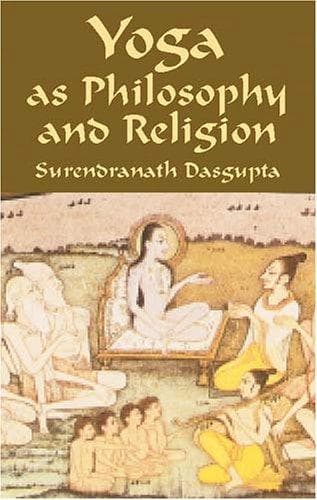
Yoga as philosophy and religionDasgupta, Surendranath
Religion
Yoga as philosophy and religion
Dasgupta, Surendranath
Hindu philosophy; Patañjali; Yoga
Thus having proved the existence of purusha, the _Kārikā_ proceeds to
prove his plurality: “_janmamaraṇakaraṇānāṃ pratiniyamādayugapat
pravṛtteśca purushabahutvaṃ siddhaṃ traiguṇyaviparyyayācca_.” “From
the individual allotment of birth, death and the organs; from
diversity of occupations and from the different conditions of the
three guṇas, it is proved that there is a plurality of souls.” In
other words, since with the birth of one individual, all are not born;
since with the death of one, all do not die; and since each individual
has separate sense organs for himself; and since all beings do not
work at the same time in the same manner; and since the qualities of
the different guṇas are possessed differently by different
individuals, purushas are many. Patañjali, though he does not infer
the plurality of purushas in this way, yet holds the view of the
sūtra, _kṛtārthaṃ prati nashṭamapyanashṭaṃ tadanyasādhāraṇatvāt_.
“Although destroyed in relation to him whose objects have been
achieved, it is not destroyed, being common to others.”
Davies, in explaining the former _Kārikā_, says: “There is, however, the
difficulty that the soul is not affected by the three guṇas. How can
their various modifications prove the individuality of souls in
opposition to the Vedāntist doctrine, that all souls are only portions
of the one, an infinitely extended monad?”
This question is the most puzzling in the Sāṃkhya doctrine. But careful
penetration of the principles of Sāṃkhya-Yoga would make clear to us
that this is a necessary and consistent outcome of the Sāṃkhya view of a
dualistic universe.
Public-domain text, read in full here on John Shaqi.
Reviews
Reviews
No reviews yet
Be the first to share your thoughts on this work.
Join the Discussion
Join the discussion
Sign in to leave a comment or review.
Sign InorCreate an account