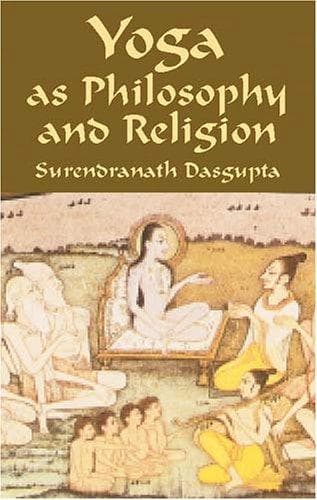
Yoga as philosophy and religionDasgupta, Surendranath
Religion
Yoga as philosophy and religion
Dasgupta, Surendranath
Hindu philosophy; Patañjali; Yoga
Describing the nature of grossness and externality, the attributes of
the external world, he says that grossness means the pervading of more
portions of space than one, i.e. grossness means extension, and
externality means being related to separate space, i.e. co-existence in
space. Thus we see that extension and co-existence in space are the two
fundamental qualities of the gross external world. Now an idea can never
be said to possess them, for it cannot be said that an idea has extended
into more spaces than one and yet co-existed separately in separate
places. An idea cannot be said to exist with other ideas in space and to
extend in many points of space at one and the same time. To avoid this
it cannot be said that there may be plurality of ideas so that some may
co-exist and others may extend in space. For co-existence and extension
can never be asserted of our ideas, since +hey are very fine and subtle,
and can be known only at the time of their individual operation, at
which time, however, other ideas may be quite latent and unknown.
Imagination has no power to negate their reality, for the sphere of
imagination is quite distinct from the sphere of external reality, and
it can never be applied to an external reality to negate it. Imagination
is a mental function, and as such has no touch with the reality outside,
which it can by no means negate.
Further it cannot be said that, because grossness and externality can
abide neither in the external world nor in our ideas, they are therefore
false. For this falsity cannot be thought as separable from our ideas,
for in that case our ideas would be as false as the false itself. The
notion of externality and grossness pervades all our ideas, and if they
are held to be false, no true thing can be known by our ideas and they
therefore become equally false.
Again, knowledge and the external world can never be said to be
identical because they happen to be presented together. For the method
of agreement cannot by itself prove identity. Knowledge and the knowable
external world may be independently co-existing things like the notions
of existence and non-existence. Both co-exist independently of one
another. It is therefore clear enough, says Vācaspati, that the
certainty arrived at by perception, which gives us a direct knowledge of
things, can never be rejected on the strength of mere logical
abstraction or hair-splitting discussion.
Public-domain text, read in full here on John Shaqi.
Reviews
Reviews
No reviews yet
Be the first to share your thoughts on this work.
Join the Discussion
Join the discussion
Sign in to leave a comment or review.
Sign InorCreate an account