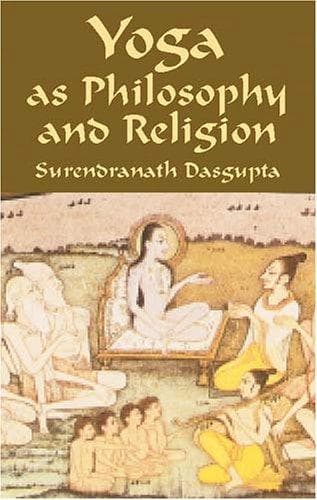
Yoga as philosophy and religionDasgupta, Surendranath
Religion
Yoga as philosophy and religion
Dasgupta, Surendranath
Hindu philosophy; Patañjali; Yoga
Yoga tacitly assumed a certain kind of analysis of the nature of these
mental states which sought to find out, if possible, the nature of their
constituent elements or moments of existence. Now in analysing the
different states of our mind we find that a particular content of
thought is illuminated and then passed over. The ideas rise, are
illuminated and pass away. Thus they found that “movement” was one of
the principal elements that constituted the substance of our thoughts.
Thought as such is always moving. This principle of movement, mutation
or change, this energy, they called rajas.
Now apart from this rajas, thought when seen as divested of its sensuous
contents seems to exhibit one universal mould or form of knowledge which
assumes the form of all the sensuous contents that are presented to it.
It is the one universal of all our particular concepts or ideas—the
basis or substratum of all the different shapes imposed upon itself, the
pure and simple. Sattva in which there is no particularity is that
element of our thought which, resembling purusha most, can attain its
reflection within itself and thus makes the unconscious mental states
intelligible. All the contents of our thought are but modes and
limitations of this universal form and are thus made intelligible. It is
the one principle of intelligibility of all our conscious states.
Now our intellectual life consists in a series of shining ideas or
concepts; concepts after concepts shine forth in the light of the pure
intelligence and pass away. But each concept is but a limitation of the
pure shining universal of our knowledge which underlies all its changing
modes or modifications of concepts or judgments. This is what is called
pure knowledge in which there is neither the knower nor the known. This
pure object—subjectless knowledge differs from the pure intelligence or
purusha only in this that later on it is liable to suffer various
modifications, as the ego, the senses, and the infinite percepts and
concepts, etc., connected therewith, whereas the pure intelligence
remains ever pure and changeless and is never the substratum of any
change. At this stage sattva, the intelligence-stuff, is prominent and
rajas and tamas are altogether suppressed. It is for this reason that
the buddhi or mind is often spoken of as the sattva. Being an absolute
preponderance of sattva it has nothing else to manifest, but it is its
pure-shining self. Both tamas and rajas being mostly suppressed they
cannot in any way affect the effulgent nature of this pure shining of
contentless knowledge in which there is neither the knower nor the
known.
But it must be remembered that it is holding suspended as it were within
itself the elements of rajas and tamas which cannot manifest themselves
owing to the preponderance of the sattva.
Public-domain text, read in full here on John Shaqi.
Reviews
Reviews
No reviews yet
Be the first to share your thoughts on this work.
Join the Discussion
Join the discussion
Sign in to leave a comment or review.
Sign InorCreate an account