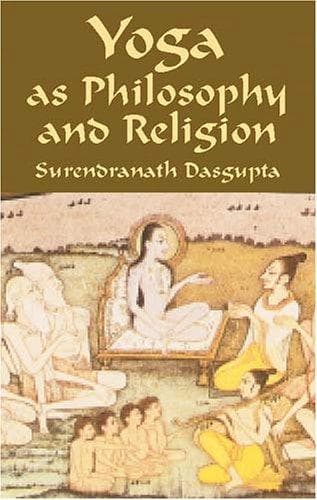
Yoga as philosophy and religionDasgupta, Surendranath
Religion
Yoga as philosophy and religion
Dasgupta, Surendranath
Hindu philosophy; Patañjali; Yoga
This notion of pure contentless consciousness is immediate and abstract
and as such is at once mediated by other necessary phases. Thus we see
that this pure contentless universal consciousness is the same as the
ego-universal (_asmitāmātra_). For this contentless universal
consciousness is only another name for the contentless unlimited,
infinite of the ego-universal. A quotation from Fichte may here be
useful as a comparison. Thus he says in the introduction to his _Science
of Ethics_: “How an object can ever become a subject, or how a being can
ever become an object of representation: this curious change will never
be explained by anyone who does not find a point where the objective and
subjective are not distinguished at all, but are altogether one. Now
such a point is established by, and made the starting point of our
system. This point is the Egohood, the Intelligence, Reason, or whatever
it may be named.”[26] The _Vyāsa-bhāshya_, II. 19, describes it as
_liṅgamātram mahattatvaṃ sattāmātre mahati ātmani_, and again in I. 36
we find it described as the waveless ocean, peaceful infinite pure
egohood. This obscure egohood is known merely as being. This mahat has
also been spoken of by Vijñāna Bhikshu as the manas, or mind, as it has
the function of assimilation (_niścaya_). Now what we have already said
about mahat will, we hope, make it clear that this mahat is the last
limit at which the subject and the object can be considered as one
indistinguishable point which is neither the one nor the other, but the
source of both.
This buddhi is thus variously called _mahat_, _asmitāmātra_, _manas_,
_sattva_, _buddhi_ and _liṅga_, according to the aspects from which this
state is observed.
This state is called mahat as it is the most universal thing conceivable
and the one common source from which all other things originate.
Now this phase of sattva or pure shining naturally passes into the other
phase, that of the Ego as knower or Ego as subject. The first phase as
mahat or asmitāmātra was the state in which the sattva was predominant
and the rajas and tamas were in a suppressed condition. The next moment
is that in which the rajas comes uppermost, and thus the ego as the
subject of all cognition—the subject I—the knower of all the mental
states—is derived. The contentless subject-objectless “I” is the passive
sattva aspect of the buddhi catching the reflection of the spirit of
purusha.
Public-domain text, read in full here on John Shaqi.
Reviews
Reviews
No reviews yet
Be the first to share your thoughts on this work.
Join the Discussion
Join the discussion
Sign in to leave a comment or review.
Sign InorCreate an account