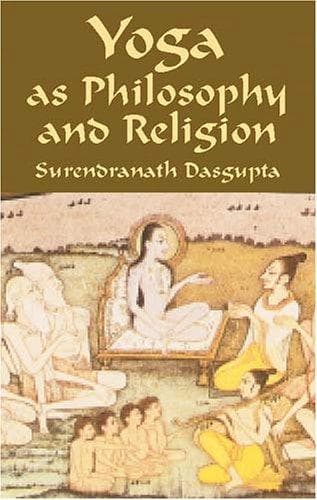
Yoga as philosophy and religionDasgupta, Surendranath
Religion
Yoga as philosophy and religion
Dasgupta, Surendranath
Hindu philosophy; Patañjali; Yoga
In its active aspect, however, it feels itself one with the spirit and
appears as the ego or subject which knows, feels and wills. Thus
Patañjali says, in II. 6: _dṛgdarśanaśaktyorekātmateva asmitā_, i.e. the
seeming identity of the seer and the perceiving capacity is called
asmitā-ego. Again in _Bhāshya_, I. 17, we have _ekātmikā saṃvidasmitā_
(knowledge as one identical is asmitā) which Vācaspati explains as _sā
ca ātmanā grahītrā saha buddhirekātmikā saṃvid_, i.e. it is the feeling
of identity of the buddhi (mind) with the self, the perceiver. Thus we
find that the mind is affected by its own rajas or activity and posits
itself as the ego or subject as activity. By reason of this position of
the “I” as active it perceives itself in the objective, in all its
conative and cognitive senses in its thoughts and feelings and also in
the external world of extension and co-existence; in the words of
Pañcaśikha (II. 5) thinking the animate and inanimate beings to be the
self, man regards their prosperity as his own and becomes glad, and
regards their adversity as his own and is sorry. Here the “I” is posited
as the active entity which becomes conscious of itself, or in other
words the “I” becomes self-conscious. In analysing this notion of
self-consciousness we find that here the rajas or element of activity or
mobility has become predominant and this predominance of rajas has been
manifested by the inherent sattva. Thus we find that the rajas side or
“I as active” has become manifested or known as such, i.e. “I” becomes
conscious of itself as active. And this is just what is meant by
self-consciousness.
This ego or self-consciousness then appears as the modification of the
contentless pure consciousness of the mind (_buddhi_); it is for this
reason that we see that this self-consciousness is but a modification of
the universal mind. The absolute identity of subject and object as the
egohood is not A part of our natural consciousness, for in all stages of
our actual consciousness, even in that of self-consciousness, there is
an element of the preponderance of rajas or activity which directs this
unity as the knower and the known and then unites them as it were. Only
so far as I distinguish myself as the conscious, from myself as the
object of consciousness, am I at all conscious of myself.
When we see that the buddhi transforms itself into the ego, the subject,
or the knower, at this its first phase there is no other content which
it can know, it therefore knows itself in a very abstract way as the
“I,” or in other words, the ego becomes self-conscious; but at this
moment the ego has no content; the tamas being quite under suppression,
it is evolved by a preponderance of the rajas; and thus its nature as
rajas is manifested by the sattva and thus the ego now essentially knows
itself to be active, and holds itself as the permanent energising
activity which connects with itself all the phenomena of our life.
Public-domain text, read in full here on John Shaqi.
Reviews
Reviews
No reviews yet
Be the first to share your thoughts on this work.
Join the Discussion
Join the discussion
Sign in to leave a comment or review.
Sign InorCreate an account