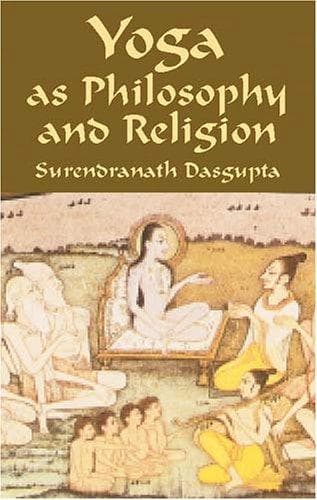
Yoga as philosophy and religionDasgupta, Surendranath
Religion
Yoga as philosophy and religion
Dasgupta, Surendranath
Hindu philosophy; Patañjali; Yoga
An enquiry into the relations of the mental phenomena to the physical
has sometimes given the first start to philosophy. The relation of mind
to matter is such an important problem of philosophy that the existing
philosophical systems may roughly be classified according to the
relative importance that has been attached to mind or to matter. There
have been chemical, mechanical and biological conceptions which have
ignored mind as a separate entity and have dogmatically affirmed it to
be the product of matter only.[1] There have been theories of the other
extreme, which have dispensed with matter altogether and have boldly
affirmed that matter as such has no reality at all, and that thought is
the only thing which can be called Real in the highest sense. All matter
as such is non-Being or Māyā or Avidyā. There have been Nihilists like
the Śūnyavādi Buddhists who have gone so far as to assert that neither
matter nor mind exists. Some have asserted that matter is only thought
externalized, some have regarded the principle of matter as the
unknowable Thing-in-itself, some have regarded them as separate
independent entities held within a higher reality called God, or as two
of his attributes only, and some have regarded their difference as being
only one of grades of intelligence, one merging slowly and imperceptibly
into the other and held together in concord with each other by
pre-established harmony.
Underlying the metaphysics of the Yoga system of thought as taught by
Patañjali and as elaborated by his commentators we find an acute
analysis of matter and thought. Matter on the one hand, mind, the
senses, and the ego on the other are regarded as nothing more than two
different kinds of modifications of one primal cause, the Prakṛti. But
the self-intelligent principle called Purusha (spirit) is distinguished
from them. Matter consists only of three primal qualities or rather
substantive entities, which he calls the Sattva or intelligence-stuff,
Rajas or energy, and Tamas—the factor of obstruction or mass or inertia.
It is extremely difficult truly to conceive of the nature of these three
kinds of entities or Guṇas, as he calls them, when we consider that
these three elements alone are regarded as composing all phenomena,
mental and physical. In order to comprehend them rightly it will be
necessary to grasp thoroughly the exact relation between the mental and
the physical. What are the real points of agreement between the two? How
can the same elements be said to behave in one case as the conceiver and
in the other case as the conceived? Thus Vācaspati says:—
“The reals (guṇas) have two forms, viz. the determiner or the perceiver,
and the perceived or the determined. In the aspect of the determined or
the perceived, the guṇas evolve themselves as the five infra-atomic
potentials, the five gross elements and their compounds. In the aspect
of perceiver or determiner, they form the modifications of the ego
together with the senses.”[2]
Public-domain text, read in full here on John Shaqi.
Reviews
Reviews
No reviews yet
Be the first to share your thoughts on this work.
Join the Discussion
Join the discussion
Sign in to leave a comment or review.
Sign InorCreate an account