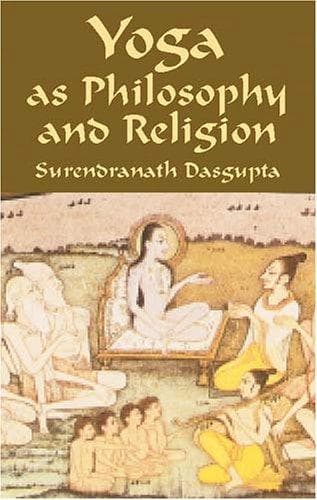
Yoga as philosophy and religionDasgupta, Surendranath
Religion
Yoga as philosophy and religion
Dasgupta, Surendranath
Hindu philosophy; Patañjali; Yoga
It is interesting to notice here the two words used by Vācaspati in
characterising the twofold aspect of the guṇa viz. _vyavasāyātmakatva_,
their nature as the determiner or perceiver, and _vyavaseyātmakatva_,
their nature as determined or perceived. The elements which compose the
phenomena of the objects of perception are the same as those which form
the phenomena of the perceiving; their only distinction is that one is
the determined and the other is the determiner. What we call the
psychosis involving intellection, sensing and the ego, and what may be
called the infra-atoms, atoms and their combinations, are but two
different types of modifications of the same stuff of reals. There is no
intrinsic difference in nature between the mental and the physical.
The mode of causal transformation is explained by Vijñāna Bhikshu in his
commentary on the system of Sāṃkhya as if its functions consisted only
in making manifest what was already there in an unmanifested form. Thus
he says, “just as the image already existing in the stone is only
manifested by the activity of the statuary, so the causal activity also
generates only that activity by which an effect is manifested as if it
happened or came into being at the present moment.”[3] The effects are
all always existent, but some of them are sometimes in an unmanifested
state. What the causal operation, viz. the energy of the agent and the
suitable collocating instruments and conditions, does is to set up an
activity by which the effect may be manifested at the present moment.
Public-domain text, read in full here on John Shaqi.
Reviews
Reviews
No reviews yet
Be the first to share your thoughts on this work.
Join the Discussion
Join the discussion
Sign in to leave a comment or review.
Sign InorCreate an account