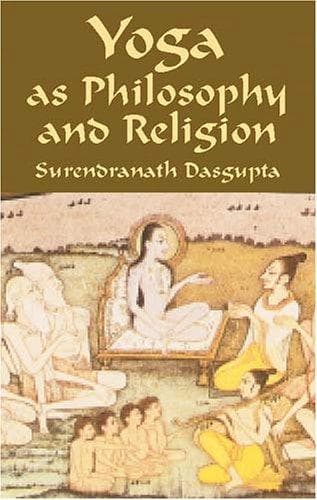
Yoga as philosophy and religionDasgupta, Surendranath
Religion
Yoga as philosophy and religion
Dasgupta, Surendranath
Hindu philosophy; Patañjali; Yoga
The _Vyāsa-bhāshya_ (III. 14) mentions four sorts of concomitant
conditions which can serve to break the barrier in a particular way and
thus determine the mode or form of the actualisations of the potential.
These are (1) ākāra, form and constitution of a thing; deśa, place, (3)
kāla, time; thus from a piece of stone, the shoot of a plant cannot
proceed, for the arrangement of the particles in stone is such that it
will oppose and stand as a bar to its potential tendencies to develop
into the shoot of a plant; of course if these barriers could be removed,
say by the will of God, as Vijñāna Bhikshu says, then it is not
impossible that the shoot of a plant might grow from a stone. By the
will of God poison may be turned into nectar and nectar into poison, and
there is no absolute certainty of the course of the evolutionary
process, for God’s will can make any change in the direction of its
process (_avyavasthitākhilapariṇāmo bhavatyeva_, III. 14).
According to the Sāṃkhya-Pātañjala theory dharma, merit, can only be
said to accrue from those actions which lead to a man’s salvation, and
adharma from just the opposite course of conduct. When it is said that
these can remove the barriers of the prakṛti and thus determine its
modifications, it amounts almost to saying that the modifications of the
prakṛti are being regulated by the moral conditions of man. According to
the different stages of man’s moral evolution, different kinds of merit,
dharma or adharma, accrue, and these again regulate the various physical
and mental phenomena according to which a man may be affected either
pleasurably or painfully. It must, however, be always remembered that
the dharma and adharma are also the productions of prakṛti, and as such
cannot affect it except by behaving as the cause for the removal of the
opposite obstructions—the dharma for removing the obstructions of
adharma and adharma for those of dharma. Vijñāna Bhikshu and Nāgeśa
agree here in saying that the modifications due to dharma and adharma
are those which affect the bodies and senses. What they mean is possibly
this, that it is dharma or adharma alone which guides the
transformations of the bodies and senses of all living beings in general
and the Yogins.
Public-domain text, read in full here on John Shaqi.
Reviews
Reviews
No reviews yet
Be the first to share your thoughts on this work.
Elsewhere in the archive
Join the Discussion
Join the discussion
Sign in to leave a comment or review.
Sign InorCreate an account