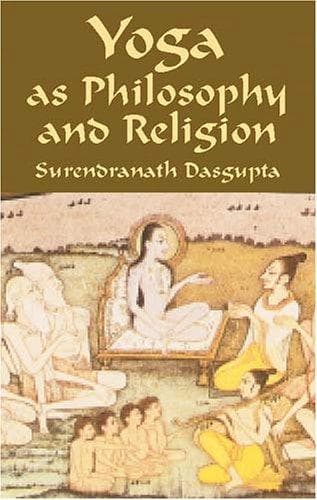
Yoga as philosophy and religionDasgupta, Surendranath
Religion
Yoga as philosophy and religion
Dasgupta, Surendranath
Hindu philosophy; Patañjali; Yoga
The body of a person and his senses are continually decaying and being
reconstructed by refilling from the gross elements and from ahaṃkāra
respectively. These refillings proceed automatically and naturally; but
they follow the teleological purpose as chalked out by the law of karma
in accordance with the virtues or vices of a man. Thus the gross insult
to which the sages were subjected by Nahusha[36] was so effective a sin
that by its influence the refilling of Nahusha’s body and the senses was
stopped and the body and senses of a snake were directly produced by a
process of refilling from the gross elements and ahaṃkāra, for providing
him with a body in which he could undergo the sufferings which were his
due owing to the enormity of his vice. Thus by his vicious action the
whole machinery of prakṛti was set in operation so that he at once died
and was immediately reborn as a snake. In another place Vācaspati “the
virtuous enjoys happiness” as an illustration of the cause of dharma and
adharma as controlling the course of the development of prakṛti. We
therefore see that the sphere of merit and demerit lies in the helping
of the formation of the particular bodies and senses (from the gross
elements and ahaṃkāra respectively) suited to all living beings
according to their stages of evolution and their growth, decay, or other
sorts of their modifications as pleasure, pain, and also as illness or
health. Thus it is by his particular merit that the Yogin can get his
special body or men or animals can get their new bodies after leaving
the old ones at death. Thus _Yoga-vārttika_ says: “Merit by removing the
obstructions of demerit causes the development of the body and the
senses.”
As for Īśvara I do not remember that the _Bhāshya_ or the sūtras ever
mention Him as having anything to do with the controlling of the
modifications of the prakṛti by removing the barriers, but all the later
commentators agree in holding him responsible for the removal of all
barriers in the way of prakṛtis development. So that Īśvara is the root
cause of all the removal of barriers, including those that are affected
by merit and demerit. Thus Vācaspati says (IV. 3): _Īśvarasyāpi
dharmādhishṭhānārthaṃ pratibandhāpanaya eva vyāpāro_, i.e. God stands as
the cause of the removal of such obstacles in the prakṛti as may lead to
the fruition of merit or demerit.
_Yoga-vārttika_ and Nāgeśa agree in holding Īśvara responsible for the
removal of all obstacles in the way of the evolution of prakṛti. Thus
Bhikshu says that God rouses prakṛti by breaking the opposing forces of
the state of equilibrium and also of the course of evolution (IV. 3).
Public-domain text, read in full here on John Shaqi.
Reviews
Reviews
No reviews yet
Be the first to share your thoughts on this work.
Elsewhere in the archive
Join the Discussion
Join the discussion
Sign in to leave a comment or review.
Sign InorCreate an account