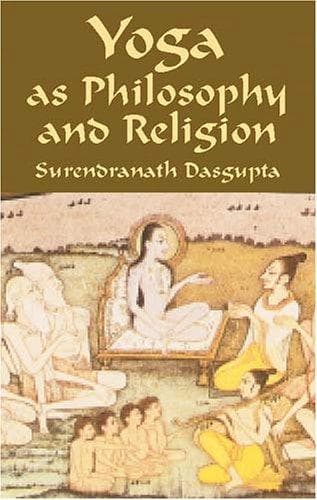
Yoga as philosophy and religionDasgupta, Surendranath
Religion
Yoga as philosophy and religion
Dasgupta, Surendranath
Hindu philosophy; Patañjali; Yoga
It is on account of God that we can do good or bad actions and thus
acquire merit or demerit. Of course God is not active and cannot cause
any motion in prakṛti. But He by His very presence causes the obstacles,
as the barriers in the way of prakṛti’s development, to be removed, in
such a way that He stands ultimately responsible for the removal of all
obstacles in the way of prakṛti’s development and thus also of all
obstacles in the way of men’s performance of good or bad deeds. Man’s
good or bad deeds “puṇyakarma,” apuṇyakarma, dharma or adharma serve to
remove the obstacles of prakṛti in such a way as to result in
pleasurable or painful effects; but it is by God’s help that the
barriers of prakṛti are removed and it yields itself in such a way that
a man may perform good or bad deeds according to his desire. Nīlakaṇṭha,
however, by his quotations in explanation of 300/2, _Śāntiparva_, leads
us to suppose that he regards God’s will as wholly responsible for the
performance of our good or bad actions. For if we lay stress on his
quotation “He makes him do good deeds whom He wants to raise, and He
makes him commit bad deeds whom He wants to throw down,” it appears that
he whom God wants to raise is made to perform good actions and he whom
God wants to throw downwards is made to commit bad actions. But this
seems to be a very bold idea, as it will altogether nullify the least
vestige of freedom in and responsibility for our actions and is
unsupported by the evidence of other commentators. Vijñāna Bhikshu also
says with reference to this śruti in his _Vijñānamṛta-bhāshya_, III. 33:
“As there is an infinite _regressus_ between the causal connection of
seed and shoot, so one karma is being determined by the previous karma
and so on; there is no beginning to this chain.” So we take the
superintendence of merits and demerits (_dharmādhispṭhānatā_) by Īśvara
to mean only in a general way the help that is offered by Him in
removing the obstructions of the external world in such a manner that it
may be possible for a man to perform practically meritorious acts in the
external world.
Nīlakaṇṭha commenting on the Yoga view says that “like a piece of
magnet, God though inactive, may by His very presence stir up prakṛti
and help His devotees. So the Yoga holds that for the granting of
emancipation God has to be admitted” (_Śāntiparva_, 300/2).
In support of our view we also find that it is by God’s influence that
the unalterable nature of the external world is held fast and a limit
imposed on the powers of man in producing changes in the external world.
Thus Vācaspati in explaining the Bhāshya (III. 45) says: “Though capable
of doing it, yet he does not change the order of things, because another
earlier omnipotent being had wished the things to be such as they were.
They would not disobey the orders of the omnipotent God.”
Public-domain text, read in full here on John Shaqi.
Reviews
Reviews
No reviews yet
Be the first to share your thoughts on this work.
Elsewhere in the archive
Join the Discussion
Join the discussion
Sign in to leave a comment or review.
Sign InorCreate an account