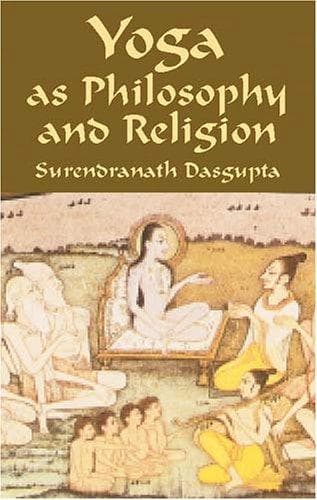
Yoga as philosophy and religionDasgupta, Surendranath
Religion
Yoga as philosophy and religion
Dasgupta, Surendranath
Hindu philosophy; Patañjali; Yoga
Men may indeed acquire unlimited powers of producing any changes they
like, for the powers of objects as they change according to the
difference of class, space, time and condition, are not permanent, and
so it is proper that they should act in accordance with the desire of
the Yogin; but there is a limit to men’s will by the command of God—thus
far and no further.
Another point in our favour is that the Yoga philosophy differs from the
Sāṃkhya mainly in this that the purushārtha or serviceability to the
purusha is only the aim or end of the evolution of prakṛti and not
actually the agent which removes the obstacles of the prakṛti in such a
way as to determine its course as this cosmical process of evolution.
Purushārtha is indeed the aim for which the process of evolution exists;
for this manifold evolution in its entirety affects the interests of the
purusha alone; but that does not prove that its teleology can really
guide the evolution on its particular lines so as to ensure the best
possible mode of serving all the interests of the purusha, for this
teleology being immanent in the prakṛti is essentially non-intelligent.
Thus Vācaspati says: “The fulfilment of the purpose of the purusha is
not also the prime mover. God has the fulfilment of the purpose of the
purusha as His own purpose, for which He behaves as the prime mover. The
fulfilment of the purpose of the purusha may be regarded as cause only
in the sense that it is the object in view of God, the prime mover.”[37]
The Sāṃkhya, however, hopes that this immanent purpose in prakṛti acts
like a blind instinct and is able to guide the course of its evolution
in all its manifold lines in accordance with the best possible service
of the purusha.
The Pātañjala view, as we have seen, maintains that Īśvara removes all
obstacles of prakṛti in such a way that this purpose may find scope for
its realisation. Thus _Sūtrārthabodhinī_, IV. 3, of Nārāyaṇa Tīrtha
says: “According to atheistic Sāṃkhya the future serviceability of
purusha alone is the mover of prakṛti. But with us theists the
serviceability of purusha is the object for which prakṛti moves. It is
merely as an object that the serviceability of the purusha may be said
to be the mover of the prakṛti.”
As regards the connection of prakṛti and purusha, however, both Sāṃkhya
and Pātañjala agree according to Vijñāna Bhikshu in denying the
interference of Īśvara; it is the movement of prakṛti by virtue of
immanent purpose that connects itself naturally with the purusha.
Vijñāna Bhikshu’s own view, however, is that this union is brought about
by God (_Vijñānāmṛta-bhāshya_, p. 34).
Public-domain text, read in full here on John Shaqi.
Reviews
Reviews
No reviews yet
Be the first to share your thoughts on this work.
Elsewhere in the archive
Join the Discussion
Join the discussion
Sign in to leave a comment or review.
Sign InorCreate an account