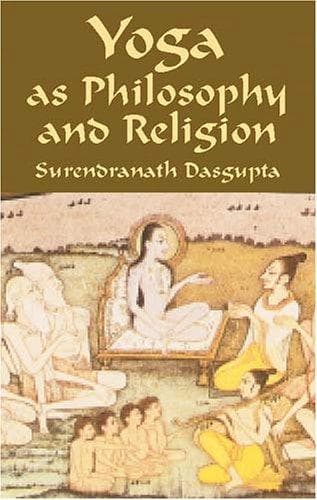
Yoga as philosophy and religionDasgupta, Surendranath
Religion
Yoga as philosophy and religion
Dasgupta, Surendranath
Hindu philosophy; Patañjali; Yoga
With Sāṃkhya-Yoga, sattva, rajas and tamas are substantive entities
which compose the reality of the mental and the physical.[4] The mental
and the physical represent two different orders of modifications, and
one is not in any way superior to the other. As the guṇas conjointly
form the manifold without, by their varying combinations, as well as all
the diverse internal functions, faculties and phenomena, they are in
themselves the absolute potentiality of all things, mental and physical.
Thus Vyāsa in describing the nature of the knowable, writes: “The nature
of the knowable is now described:—The knowable, consisting of the
objects of enjoyment and liberation, as the gross elements and
the perceptive senses, is characterised by three essential
traits—illumination, energy and inertia. The sattva is of the nature of
illumination. Rajas is of the nature of energy. Inertia (tamas) is of
the nature of inactivity. The guṇa entities with the above
characteristics are capable of being modified by mutual influence on one
another, by their proximity. They are evolving. They have the
characteristics of conjunction and separation. They manifest forms by
one lending support to the others by proximity. None of these loses its
distinct power into those of the others, even though any one of them may
exist as the principal factor of a phenomenon with the others as
subsidiary thereto. The guṇas forming the three classes of substantive
entities manifest themselves as such by their similar kinds of power.
When any one of them plays the rôle of the principal factor of any
phenomenon, the others also show their presence in close contact. Their
existence as subsidiary energies of the principal factor is inferred by
their distinct and independent functioning, even though it be as
subsidiary qualities.”[5] The Yoga theory does not acknowledge qualities
as being different from substances. The ultimate substantive entities
are called guṇas, which as we have seen are of three kinds. The guṇa
entities are infinite in number; each has an individual existence, but
is always acting in co-operation with others. They may be divided into
three classes in accordance with their similarities of behaviour (śīla).
Those which behave in the way of intellection are called _sattva_, those
which behave in the way of producing effort of movement are called
_rajas_, and those which behave differently from these and obstruct
their process are called _tamas_. We have spoken above of a primal cause
_prakṛti_. But that is not a separate category independent of the guṇas.
Prakṛti is but a name for the guṇa entities when they exist in a state
of equilibrium. All that exists excepting the purushas are but the guṇa
entities in different kinds of combination amongst themselves. The
effects they produce are not different from them but it is they
themselves which are regarded as causes in one state and effects in
another. The difference of combination consists in this, that in some
Public-domain text, read in full here on John Shaqi.
Reviews
Reviews
No reviews yet
Be the first to share your thoughts on this work.
Join the Discussion
Join the discussion
Sign in to leave a comment or review.
Sign InorCreate an account