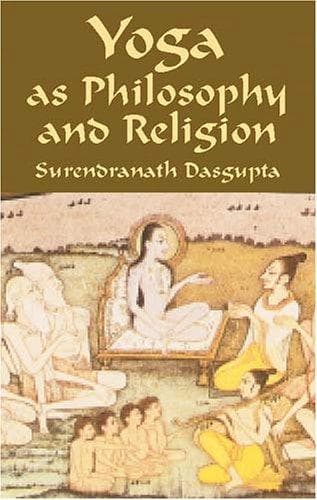
Yoga as philosophy and religionDasgupta, Surendranath
Religion
Yoga as philosophy and religion
Dasgupta, Surendranath
Hindu philosophy; Patañjali; Yoga
All states are modifications of the three guṇas; in each one of them the
functions of all the three guṇas are seen, contrary to one another.
These contraries are observable in their developed forms, for the guṇas
are seen to abide in various proportions and compose all our mental
states. Thus a Yogin who wishes to be released from pain once for all is
very sensitive and anxious to avoid even our so-called pleasures. The
wise are like the eye-ball. As a thread of wool thrown into the eye
pains by merely touching it, but not when it comes into contact with any
other organ, so the Yogin is as tender as the eye-ball, when others are
insensible of pain. Ordinary persons, however, who have again and again
suffered pains as the consequence of their own karma, and who again seek
them after having given them up, are all round pierced through as it
were by nescience, their minds become full of afflictions, variegated by
the eternal residua of the passions. They follow in the wake of the “I”
and the “Mine” in relation to things that should be left apart, pursuing
threefold pain in repeated births, due to external and internal causes.
The Yogin seeing himself and the world of living beings surrounded by
the eternal flow of pain, turns for refuge to right knowledge, cause of
the destruction of all pains (_Vyāsa-bhāshya_, II. 15).
Thinking of the mind and body and the objects of the external world as
the true self and feeling affected by their change is avidyā (false
knowledge).
The modifications that this avidyā suffers may be summarised under four
heads.
I. The ego, which, as described above, springs from the identification
of the buddhi with the purusha.
II. From this ego springs attachment (_rāga_) which is the inclination
towards pleasure and consequently towards the means necessary for
attaining it in a person who has previously experienced pleasures and
remembers them.
II. Repulsion from pain also springs from the ego and is of the nature
of anxiety for its removal; anger at pain and the means which produces
pain, remains in the mind in consequence of the feeling of pain, in the
case of him who has felt and remembers pain.
IV. Love of life also springs from the ego. This feeling exists in all
persons and appears in a positive aspect in the form “would that I were
never to cease.” This is due to the painful experience of death in some
previous existence, which abides in us as a residual potency (_vāsanā_)
and causes the instincts of self-preservation, fear of death and love of
life. These modifications including avidyā are called the five kleśas or
afflictions.
Public-domain text, read in full here on John Shaqi.
Reviews
Reviews
No reviews yet
Be the first to share your thoughts on this work.
Elsewhere in the archive
Join the Discussion
Join the discussion
Sign in to leave a comment or review.
Sign InorCreate an account