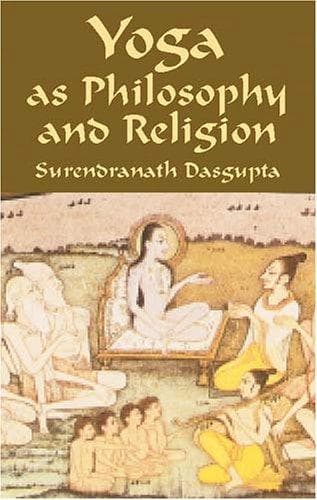
Yoga as philosophy and religionDasgupta, Surendranath
Religion
Yoga as philosophy and religion
Dasgupta, Surendranath
Hindu philosophy; Patañjali; Yoga
We are now in a position to see the far-reaching effects of the
identification of the purusha with the buddhi. We have already seen how
it has generated the macrocosm or external world on the one hand, and
manas and the senses on the other. Now we see that from it also spring
attachment to pleasure, aversion from pain and love of life, motives
observable in most of our states of consciousness, which are therefore
called the _klishṭa vṛtti_ or afflicted states. The five afflictions
(false knowledge and its four modifications spoken above) just mentioned
are all comprehended in avidyā, since avidyā or false knowledge is at
the root of all worldly experiences. The sphere of avidyā is all false
knowledge generally, and that of asmitā is also inseparably connected
with all our experiences which consist in the identification of the
intelligent self with the sensual objects of the world, the attainment
of which seems to please us and the loss of which is so painful to us.
It must, however, be remembered that these five afflictions are only
different aspects of avidyā and cannot be conceived separately from
avidyā. These always lead us into the meshes of the world, far from our
final goal—the realisation of our own self—emancipation of the purusha.
Opposed to it are the vṛttis or states which are called unafflicted,
aklishṭa, the habit of steadiness (_abhyāsa_) and non-attachment to
pleasures (_vairāgya_) which being antagonistic to the afflicted states,
are helpful towards achieving true knowledge. These represent such
thoughts as tend towards emancipation and are produced from our attempts
to conceive rationally our final state of emancipation, or to adopt
suitable means for this. They must not, however, be confused with
puṇyakarma (virtuous action), for both puṇya and pāpa karma are said to
have sprung from the kleśas. There is no hard and fast rule with regard
to the appearance of these klishṭa and aklishṭa states, so that in the
stream of the klishṭa states or in the intervals thereof, aklishṭa
states may also appear—as practice and desirelessness born from the
study of the Veda-reasoning and precepts—and remain quite distinct in
itself, unmixed with the klishṭa states. A Brahman being in a village
which is full of the Kirātas, does not himself become a Kirāta (a forest
tribe) for that reason.
Each aklishṭa state produces its own potency or saṃskāra, and with the
frequency of the states their saṃskāra is strengthened which in due
course suppresses the aklishṭa states.
Public-domain text, read in full here on John Shaqi.
Reviews
Reviews
No reviews yet
Be the first to share your thoughts on this work.
Elsewhere in the archive
Join the Discussion
Join the discussion
Sign in to leave a comment or review.
Sign InorCreate an account