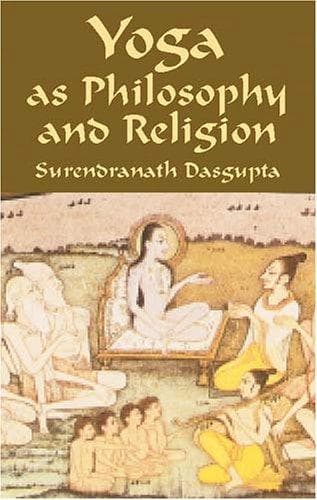
Yoga as philosophy and religionDasgupta, Surendranath
Religion
Yoga as philosophy and religion
Dasgupta, Surendranath
Hindu philosophy; Patañjali; Yoga
These klishṭa and aklishṭa modifications are of five descriptions:
pramāṇa (real cognition), viparyyaya (unreal cognition), vikalpa
(logical abstraction and imagination), nidrā (sleep), smṛti (memory).
These vṛttis or states, however, must be distinguished from the six
kinds of mental activity mentioned in _Vyāsa-bhāshya_, II. 18: grahaṇa
(reception or presentative ideation), dhāraṇa (retention), ūha
(assimilation), apoha (differentiation), tattvajñāna (right knowledge),
abhiniveśa (decision and determination), of which these states are the
products.
We have seen that from avidyā spring all the kleśas or afflictions,
which are therefore seen to be the source of the klishṭa vṛttis as well.
Abhyāsa and vairāgya—the aklishṭa vṛttis, which spring from precepts,
etc., lead to right knowledge, and as such are antagonistic to the
modification of the guṇas on the avidyā side.
We know also that both these sets of vṛttis—the klishṭa and the
aklishṭa—produce their own kinds of saṃskāras, the klishṭa saṃskāra and
the aklishṭa or prajñā saṃskāra. All these modifications of citta as
vṛtti and saṃskāra are the dharmas of citta, considered as the dharmin
or substance.
CHAPTER IX
THE THEORY OF KARMA
The vṛttis are called the mānasa karmas (mental work) as different from
the bāhya karmas (external work) achieved in the exterior world by the
five motor or active senses. These may be divided into four classes: (1)
kṛshṇa (black), (2) śukla (white), (3) śuklakṛshṇa (white and black),
(4) aśuklākṛshṇa (neither white nor black). (1) The kṛshṇa karmas are
those committed by the wicked and, as such, are wicked actions called
also adharma (demerit). These are of two kinds, viz. bāhya and mānasa,
the former being of the nature of speaking ill of others, stealing
others’ property, etc., and the latter of the nature of such states as
are opposed to śraddhā, vīrya, etc., which are called the śukla karma.
(2) The śukla karmas are virtuous or meritorious deeds. These can only
occur in the form of mental states, and as such can take place only in
the mānasa karma. These are śraddhā (faith), vīrya (strength), smṛti
(meditation), samādhi (absorption), and prajñā (wisdom), which are
infinitely superior to actions achieved in the external world by the
motor or active senses. The śukla karma belongs to those who resort to
study and meditation. (3) The śuklakṛshṇa karma are the actions achieved
in the external world by the motor or active senses. These are called
white and black, because actions achieved in the external world, however
good (śukla) they might be, cannot be altogether devoid of wickedness
(kṛshṇa), since all external actions entail some harm to other living
beings.
Even the Vedic duties, though meritorious, are associated with sins, for
they entail the sacrificing of animals.[40]
Public-domain text, read in full here on John Shaqi.
Reviews
Reviews
No reviews yet
Be the first to share your thoughts on this work.
Elsewhere in the archive
Join the Discussion
Join the discussion
Sign in to leave a comment or review.
Sign InorCreate an account