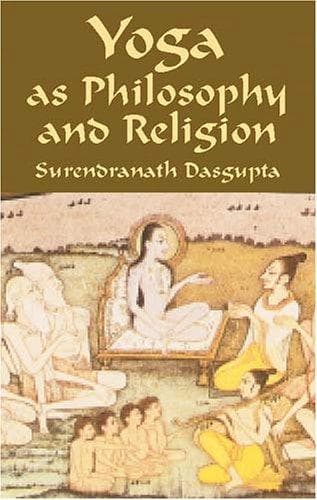
Yoga as philosophy and religionDasgupta, Surendranath
Religion
Yoga as philosophy and religion
Dasgupta, Surendranath
Hindu philosophy; Patañjali; Yoga
The white side of these actions, viz.: that of helping others and doing
good is therefore called dharma, as it is the cause of the enjoyment of
pleasure and happiness for the doer. The kṛshṇa or black side of these
actions, viz. that of doing injury to others is called adharma, as it is
the cause of the suffering of pain to the doer. In all our ordinary
states of existence we are always under the influence of dharma and
adharma, which are therefore called vehicles of actions (_āśerate
sāṃsārikā purushā asmin niti āśayaḥ_). That in which some thing lives is
its vehicle. Here the purushas in evolution are to be understood as
living in the sheath of actions (which is for that reason called a
vehicle or āśaya). Merit or virtue, and sin or demerit are the vehicles
of actions. All śukla karma, therefore, either mental or external, is
called merit or virtue and is productive of happiness; all kṛshṇa karma,
either mental or external, is called demerit, sin or vice and is
productive of pain.
(4) The karma called aśuklakṛshṇa (neither black nor white) is of those
who have renounced everything, whose afflictions have been destroyed and
whose present body is the last one they will have. Those who have
renounced actions, the karma-sannyāsis (and not those who belong to the
sannyāsāśrama merely), are nowhere found performing actions which depend
upon external means. They have not got the black vehicle of actions,
because they do not perform such actions. Nor do they possess the white
vehicle of actions, because they dedicate to Īśvara the fruits of all
vehicles of action, brought about by the practice of Yoga.
Returning to the question of karmāśaya again for review, we see that
being produced from desire (_kāma_), avarice (_lobha_), ignorance
(_moha_), and anger (_krodha_) it has really got at its root the kleśas
(afflictions) such as avidyā (ignorance), asmitā (egoism), rāga
(attachment), dvesha (antipathy), abhiniveśa (love of life). It will be
easily seen that the passions named above, desire, lust, etc., are not
in any way different from the kleśas or afflictions previously
mentioned; and as all actions, virtuous or sinful, have their springs in
the said sentiments of desire, anger, covetousness, and infatuation, it
is quite enough that all these virtuous or sinful actions spring from
the kleśas.
Public-domain text, read in full here on John Shaqi.
Reviews
Reviews
No reviews yet
Be the first to share your thoughts on this work.
Elsewhere in the archive
Join the Discussion
Join the discussion
Sign in to leave a comment or review.
Sign InorCreate an account