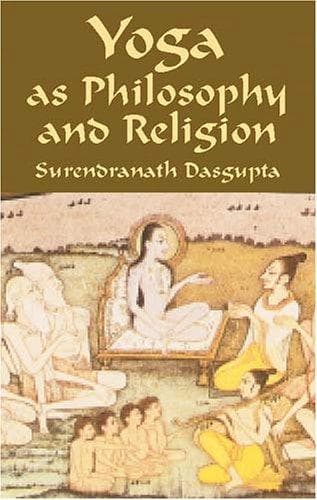
Yoga as philosophy and religionDasgupta, Surendranath
Religion
Yoga as philosophy and religion
Dasgupta, Surendranath
Hindu philosophy; Patañjali; Yoga
Now this karmāśaya ripens into life-state, life-experience and
life-time, if the roots—the afflictions—exist. Not only is it true that
when the afflictions are rooted out, no karmāśaya can accumulate, but
even when many karmāśayas of many lives are accumulated, they are rooted
out when the afflictions are destroyed. Otherwise, it is difficult to
conceive that the karmāśaya accumulated for an infinite number of years,
whose time of ripeness is uncertain, will be rooted out! So even if
there be no fresh karmāśaya after the rise of true knowledge, the
purusha cannot be liberated but will be required to suffer an endless
cycle of births and rebirths to exhaust the already accumulated
karmāśayas of endless lives. For this reason, the mental plane becomes a
field for the production of the fruits of action only, when it is
watered by the stream of afflictions. Hence the afflictions help the
vehicle of actions (karmāśaya) in the production of their fruits also.
It is for this reason that when the afflictions are destroyed the power
which helps to bring about the manifestation also disappears; and on
that account the vehicles of actions although existing in innumerable
quantities have no time for their fruition and do not possess the power
of producing fruit, because their seed-powers are destroyed by
intellection.
Karmāśaya is of two kinds. (1) Ripening in the same life
_dṛshṭajanmavedanīya_. (2) Ripening in another unknown life. That puṇya
karmāśaya, which is generated by intense purificatory action, trance and
repetition of mantras, and that pāpa karmāśaya, which is generated by
repeated evil done either to men who are suffering the extreme misery of
fear, disease and helplessness, or to those who place confidence in them
or to those who are high-minded and perform tapas, ripen into fruit in
the very same life, whereas other kinds of karmāśayas ripen in some
unknown life.
Living beings in hell have no dṛshṭajanma karmāśaya, for this life is
intended for suffering only and their bodies are called the
bhoga-śarīras intended for suffering alone and not for the accumulation
of any karmāśaya which could take effect in that very life.
There are others whose afflictions have been spent and exhausted and
thus they have no such karmāśaya, the effect of which they will have
to reap in some other life. They are thus said to have no
adṛshṭa-janmavedanīya karma.
Public-domain text, read in full here on John Shaqi.
Reviews
Reviews
No reviews yet
Be the first to share your thoughts on this work.
Elsewhere in the archive
Join the Discussion
Join the discussion
Sign in to leave a comment or review.
Sign InorCreate an account