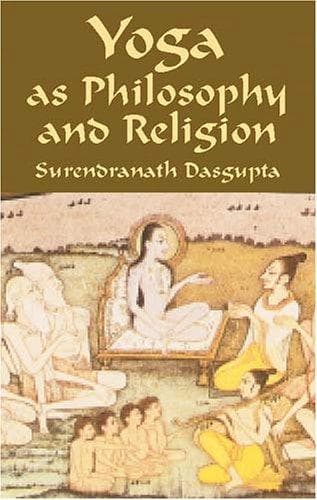
Yoga as philosophy and religionDasgupta, Surendranath
Religion
Yoga as philosophy and religion
Dasgupta, Surendranath
Hindu philosophy; Patañjali; Yoga
In the first stages, when the mind attains discriminative knowledge, the
prajñā is not deeply seated, and occasionally phenomenal states of
consciousness are seen to intervene in the form of “I am,” “Mine,” “I
know,” “I do not know,” because the old potencies, though becoming
weaker and weaker are not finally destroyed, and consequently
occasionally produce their corresponding conscious manifestation as
states which impede the flow of discriminative knowledge. But constant
practice in rooting out the potency of this state destroys the potencies
of the outgoing activity, and finally no intervention occurs in the flow
of the stream of prajñā through the destructive influence of phenomenal
states of consciousness. In this higher state when the mind is in its
natural, passive, and objectless stream of flowing prajñā, it is called
the dharmamegha-saṁādhi. When nothing is desired even from dhyāna arises
the true knowledge which distinguishes prakṛti from purusha and is
called the dharmamegha-samādhi (_Yoga-sūtra_, IV. 29). The potency,
however, of this state of consciousness lasts until the purusha is
finally liberated from the bonds of prakṛti and is absolutely free
(kevalī). Now this is the state when the citta becomes infinite, and all
its tamas being finally overcome, it shines forth like the sun, which
can reflect all, and in comparison to which the crippled insignificant
light of objective knowledge shrinks altogether, and thus an infinitude
is acquired, which has absorbed within itself all finitude, which cannot
have any separate existence or manifestation through this infinite
knowledge. All finite states of knowledge are only a limitation of true
infinite knowledge, in which there is no limitation of this and that. It
absorbs within itself all these limitations.
The purusha in this state may be called the emancipated being,
jīvanmukta. Nāgeśa in explaining _Vyāsa-bhāshya_, IV. 31, describing the
emancipated life says: “In this jīvanmukta stage, being freed from all
impure afflictions and karmas, the consciousness shines in its
infirmity. The infiniteness of consciousness is different from the
infiniteness of materiality veiled by tamas. In those stages there could
be consciousness only with reference to certain things with reference to
which the veil of tamas was raised by rajas. When all veils and
impurities are removed, then little is left which is not known. If there
were other categories besides the 25 categories, these also would then
have been known” (_Chāyāvyākhyā_, IV. 31).
Public-domain text, read in full here on John Shaqi.
Reviews
Reviews
No reviews yet
Be the first to share your thoughts on this work.
Elsewhere in the archive
Join the Discussion
Join the discussion
Sign in to leave a comment or review.
Sign InorCreate an account