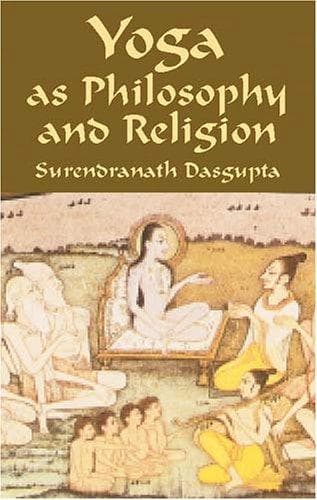
Yoga as philosophy and religionDasgupta, Surendranath
Religion
Yoga as philosophy and religion
Dasgupta, Surendranath
Hindu philosophy; Patañjali; Yoga
Now with the rise of such dharmamegha the succession of the changes of
the qualities is over, inasmuch as they have fulfilled their object by
having achieved experience and emancipation, and their succession having
ended, they cannot stay even for a moment. And now comes absolute
freedom, when the guṇas return back to the pradhāna their primal cause,
after performing their service for the purusha by providing his
experience and his salvation, so that they lose all their hold on
purusha and purusha remains as he is in himself, and never again has any
connection with the buddhi. The purusha remains always in himself in
absolute freedom.
The order of the return of the guṇas for a kevalī purusha is described
below in the words of Vācaspati: The guṇas as cause and effect involving
ordinary experiences samādhi and nirodha, become submerged in the manas;
the manas becomes submerged in the asmitā, the asmitā in the liṅga, and
the liṅga in the aliṅga.
This state of kaivalya must be distinguished from the state of
mahāpralaya in which also the guṇas return back to prakṛti, for that
state is again succeeded by later connections of prakṛti with purushas
through the buddhis, but the state of kaivalya is an eternal state which
is never again disturbed by any connection with prakṛti, for now the
separation of prakṛti from purusha is eternal, whereas that in the
mahāpralaya state was only temporary.
We shall conclude this section by noting two kinds of eternity of
purusha and of prakṛti, and by offering a criticism of the prajñā state.
The former is said to be perfectly and unchangeably eternal (_kūṭastha
nitya_), and the latter is only eternal in an evolutionary form. The
permanent or eternal reality is that which remains unchanged amid its
changing appearances; and from this point of view both purusha and
prakṛti are eternal. It is indeed true, as we have seen just now, that
the succession of changes of qualities with regard to buddhi, etc.,
comes to an end when kaivalya is attained, but this is with reference to
purusha, for the changes of qualities in the guṇas themselves never come
to an end. So the guṇas in themselves are eternal in their changing or
evolutionary character, and are therefore said to possess evolutionary
eternity (_pariṇāminityatā_). Our phenomenal conception cannot be free
from change, and therefore it is that in our conception of the released
purushas we affirm their existence, as for example when we say that the
released purushas exist eternally. But it must be carefully noted that
this is due to the limited character of our thoughts and expressions,
not to the real nature of the released purushas, which remain for ever
unqualified by any changes or modifications, pure and colourless as the
very self of shining intelligence (see _Vyāsa-bhāshya_, IV. 33).
Public-domain text, read in full here on John Shaqi.
Reviews
Reviews
No reviews yet
Be the first to share your thoughts on this work.
Elsewhere in the archive
Join the Discussion
Join the discussion
Sign in to leave a comment or review.
Sign InorCreate an account