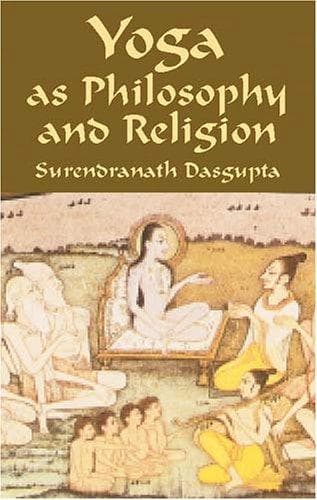
Yoga as philosophy and religionDasgupta, Surendranath
Religion
Yoga as philosophy and religion
Dasgupta, Surendranath
Hindu philosophy; Patañjali; Yoga
VII. The seventh and last aspect of the guṇas is that they never return
back to bind purusha again, their teleological purpose being fulfilled
or realised. It is of course easy to see that, in these last three
stages, purusha has nothing to do; but the guṇas of their own nature
suffer these backward modifications and return back to their own primal
cause and leave the purusha kevalī (for ever solitary). _Vyāsa-bhāshya_,
II. 15.
Vyāsa says that as the science of medicine has four divisions: (1)
disease, (2) the cause of disease, (3) recovery, (4) medicines; so this
Yoga philosophy has also four divisions, viz.: (I) Saṃsāra (the
evolution of the prakṛti in connection with the purusha). (II) The cause
of saṃsāra. (III) Release. (IV) The means of release.
Of these the first three have been described at some length above. We
now direct our attention to the fourth. We have shown above that the
ethical goal, the ideal to be realised, is absolute freedom or kaivalya,
and we shall now consider the line of action that must be adopted to
attain this goal—the _summum bonum_. All actions which tend towards the
approximate realisation of this goal for man are called kuśala, and the
man who achieves this goal is called kuśalī. It is in the inherent
purpose of prakṛti that man should undergo pains which include all
phenomenal experiences of pleasures as well, and ultimately adopt such a
course of conduct as to avoid them altogether and finally achieve the
true goal, the realisation of which will extinguish all pains for him
for ever. The motive therefore which prompts a person towards this
ethico-metaphysical goal is the avoidance of pain. An ordinary man feels
pain only in actual pain, but a Yogin who is as highly sensitive as the
eye-ball, feels pain in pleasure as well, and therefore is determined to
avoid all experiences, painful or so-called pleasurable. The
extinguishing of all experiences, however, is not the true ethical goal,
being only a means to the realisation of kaivalya or the true self and
nature of the purusha. But this means represents the highest end of a
person, the goal beyond which all his duties cease; for after this comes
kaivalya which naturally manifests itself on the necessary retirement of
the prakṛti. Purusha has nothing to do in effectuating this state, which
comes of itself. The duties of the purusha cease with the thorough
extinguishing of all his experiences. This therefore is the means of
extinguishing all his pains, which are the highest end of all his
duties; but the complete extinguishing of all pains is identical with
the extinguishing of all experiences, the states or vṛttis of
consciousness, and this again is identical with the rise of prajñā or
true discriminative knowledge of the difference in nature of prakṛti and
its effects from the purusha—the unchangeable. These three sides are
only the three aspects of the same state which immediately precede
kaivalya.
Public-domain text, read in full here on John Shaqi.
Reviews
Reviews
No reviews yet
Be the first to share your thoughts on this work.
Elsewhere in the archive
Join the Discussion
Join the discussion
Sign in to leave a comment or review.
Sign InorCreate an account