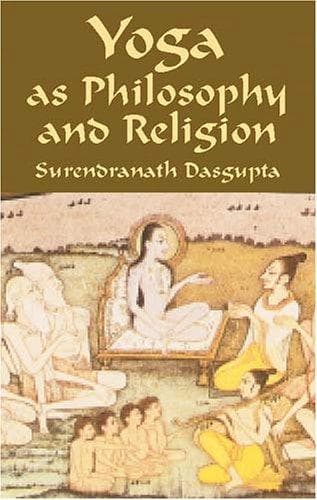
Yoga as philosophy and religionDasgupta, Surendranath
Religion
Yoga as philosophy and religion
Dasgupta, Surendranath
Hindu philosophy; Patañjali; Yoga
The prajñā aspect is the aspect of the highest knowledge, the
suppression of the states of consciousness or experiences, and it is the
aspect of the cessation of all conscious activity and of painlessness or
the extinguishing of all pains as the feeling aspect of the same
nirvīja—samādhi state. But when the student directs his attention to
this goal in his ordinary states of experience, he looks at it from the
side of the feeling aspect, viz. that of acquiring a state of
painlessness, and as a means thereto he tries to purify the mind and be
moral in all his actions, and begins to restrain and suppress his mental
states, in order to acquire this nirvīja or seedless state. This is the
sphere of conduct which is called Yogāṅga.
Of course there is a division of duties according to the advancement of
the individual, as we shall have occasion to show hereafter. This
suppression of mental states which has been described as the means of
attaining final release, the ultimate ethical goal of life, is called
Yoga. We have said before that of the five kinds of mind—kshipta, mūḍha,
vikshipta, ekāgra, niruddha—only the last two are fit for the process of
Yoga and ultimately acquire absolute freedom. In the other three, though
concentration may occasionally happen, yet there is no extrication of
the mind from the afflictions of avidyā and consequently there is no
final release.
CHAPTER XI
YOGA PRACTICE
The Yoga which, after weakening the hold of the afflictions and causing
the real truth to dawn upon our mental vision, gradually leads us
towards the attainment of our final goal, is only possible for the last
two kinds of minds and is of two kinds: (1) samprajñāta (cognitive) and
(2) asamprajñāta (ultra-cognitive). The samprajñāta Yoga is that in
which the mind is concentrated upon some object, external or internal,
in such a way that it does not oscillate or move from one object to
another, but remains fixed and settled in the object that it holds
before itself. At first, the Yogin holds a gross material object before
his view, but when he can make himself steady in doing this, he tries
with the subtle tanmātras, the five causes of the grosser elements, and
when he is successful in this he takes his internal senses as his object
and last of all, when he has fully succeeded in these attempts, he takes
the great egohood as his object, in which stage his object gradually
loses all its determinate character and he is said to be in a state of
suppression in himself, although devoid of any object. This state, like
the other previous states of the samprajñāta type, is a positive state
of the mind and not a mere state of vacuity of objects or negativity. In
this state, all determinate character of the states disappears and their
potencies only remain alive. In the first stages of a Yogin practising
samādhi conscious states of the lower stages often intervene, but
Public-domain text, read in full here on John Shaqi.
Reviews
Reviews
No reviews yet
Be the first to share your thoughts on this work.
Elsewhere in the archive
Join the Discussion
Join the discussion
Sign in to leave a comment or review.
Sign InorCreate an account