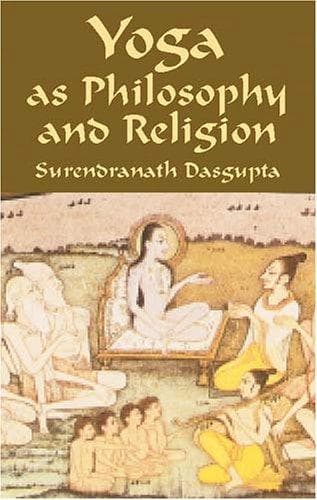
Yoga as philosophy and religionDasgupta, Surendranath
Religion
Yoga as philosophy and religion
Dasgupta, Surendranath
Hindu philosophy; Patañjali; Yoga
gradually, as the mind becomes fixed, the potencies of the lower stages
are overcome by the potencies of this stage, so that the mind flows in a
calm current and at last the higher prajñā dawns, whereupon the
potencies of this state also are burnt and extinguished, the citta
returns back to its own primal cause, prakṛti, and purusha attains
absolute freedom.
The first four stages of the samprajñāta state are called _madhumatī_,
_madhupratīka_, _viśoka_ and the _saṃskāraśesha_ and also
_vitarkānugata_, _vicārānugata_, _ānandānugata_ and _asmitānugata_. True
knowledge begins to dawn from the first stage of this samprajñāta state,
and when the Yogin reaches the last stage the knowledge reaches its
culminating point, but still so long as the potencies of the lower
stages of relative knowledge remain, the knowledge cannot obtain
absolute certainty and permanency, as it will always be threatened with
a possible encroachment by the other states of the past phenomenal
activity now existing as the subconscious. But the last stage of
asamprajñāta samādhi represents the stage in which the ordinary
consciousness has been altogether surpassed and the mind is in its own
true infinite aspect, and the potencies of the stages in which the mind
was full of finite knowledge are also burnt, so that with the return of
the citta to its primal cause, final emancipation is effected. The last
state of samprajñāta samādhi is called saṃskāraśesha, only because here
the residua of the potencies of subconscious thought only remain and the
actual states of consciousness become all extinct. It is now easy to see
that no mind which is not in the ekāgra or one-pointed state can be fit
for the asamprajñāta samādhi in which it has to settle itself on one
object and that alone. So also no mind which has not risen to the state
of highest suppression is fit for the asamprajñāta or nirvīja state.
It is now necessary to come down to a lower level and examine the
obstructions, on account of which a mind cannot easily become
one-pointed or ekāgra. These, nine in number, are the following:—
Disease, languor, indecision, want of the mental requirements necessary
for samādhi, idleness of body and mind, attachment to objects of sense,
false and illusory knowledge, non-attainment of the state of
concentrated contemplation, unsteadiness and unstability of the mind in
a samādhi state even if it can somehow attain it. These are again seen
to be accompanied with pain and despair owing to the non-fulfilment of
desire, physical shakiness or unsteadiness of the limbs, taking in of
breath and giving out of it, which are seen to follow the nine
distractions of a distracted mind described above.
Public-domain text, read in full here on John Shaqi.
Reviews
Reviews
No reviews yet
Be the first to share your thoughts on this work.
Elsewhere in the archive
Join the Discussion
Join the discussion
Sign in to leave a comment or review.
Sign InorCreate an account