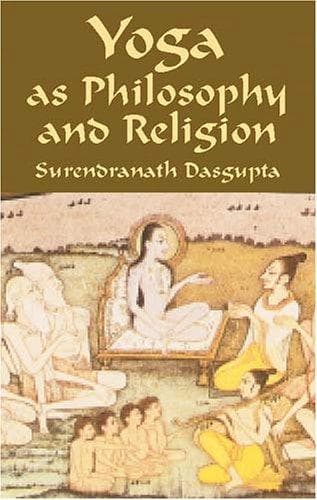
Yoga as philosophy and religionDasgupta, Surendranath
Religion
Yoga as philosophy and religion
Dasgupta, Surendranath
Hindu philosophy; Patañjali; Yoga
In its negative aspect, vairāgya is of two kinds, apara and para. The
apara is that of a mind free from attachment to worldly enjoyments, such
as women, food, drinks and power, as also from thirst for heavenly
pleasures attainable by practising the vedic rituals and sacrifices.
Those who are actuated by apara vairāgya do not desire to remain in a
bodiless state (_videha_) merged in the senses or merged in the prakṛti
(_prakṛtilīna_). It is a state in which the mind is indifferent to all
kinds of pleasures and pains. This vairāgya may be said to have four
stages: (1) Yatamāna—in which sensual objects are discovered to be
defective and the mind recoils from them. (2) Vyatireka—in which the
senses to be conquered are noted. (3) Ekendriya—in which attachment
towards internal pleasures and aversion towards external pains, being
removed, the mind sets before it the task of removing attachment and
aversion towards mental passions for obtaining honour or avoiding
dishonour, etc. (4) The fourth and last stage of vairāgya called
vaśīkāra is that in which the mind has perceived the futility of all
attractions towards external objects of sense and towards the pleasures
of heaven, and having suppressed them altogether feels no attachment,
even should it come into connection with them.
With the consummation of this last stage of apara vairāgya, comes the
para vairāgya which is identical with the rise of the final prajñā
leading to absolute independence. This vairāgya, śraddhā and the abhyāsa
represent the unafflicted states (aklishṭavṛtti) which suppress
gradually the klishṭa or afflicted mental states. These lead the Yogin
from one stage to another, and thus he proceeds higher and higher until
the final state is attained.
As vairāgya advances, śraddhā also advances; from śraddhā comes vīrya,
energy, or power of concentration (_dhāraṇā_); and from it again springs
smṛti—or continuity of one object of thought; and from it comes samādhi
or cognitive and ultra-cognitive trance; after which follows prajñā,
cognitive and ultra-cognitive trance; after which follows prajñā and
final release. Thus by the inclusion of śraddhā within vairāgya, its
effect, and the other products of śraddhā with abhyāsa, we see that the
abhyāsa and vairāgya are the two internal means for achieving the final
goal of the Yogin, the supreme suppression and extinction of all states
of consciousness, of all afflictions and the avidyā—the last state of
supreme knowledge or prajñā.
As śraddhā, vīrya, smṛti, samādhi which are not different from vairāgya
and abhyāsa (they being only their other aspects or simultaneous
products), are the means of attaining Yoga, it is possible to make a
classification of the Yogins according to the strength of these with
each, and the strength of the quickness (_saṃvega_) with which they may
be applied towards attaining the goal of the Yogin. Thus Yogins are of
nine kinds:—
(1) mildly energetic, (2) of medium energy, (3) of intense energy.
Public-domain text, read in full here on John Shaqi.
Reviews
Reviews
No reviews yet
Be the first to share your thoughts on this work.
Elsewhere in the archive
Join the Discussion
Join the discussion
Sign in to leave a comment or review.
Sign InorCreate an account