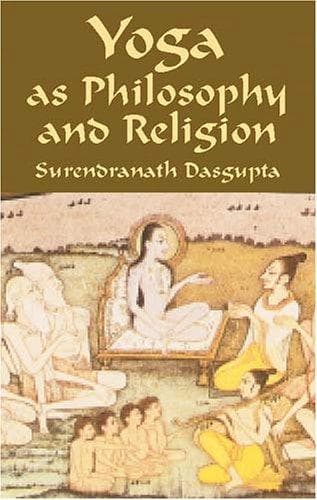
Yoga as philosophy and religionDasgupta, Surendranath
Religion
Yoga as philosophy and religion
Dasgupta, Surendranath
Hindu philosophy; Patañjali; Yoga
Each of these may vary in a threefold way according to the mildness,
medium state, or intensity of quickness or readiness with which the
Yogin may apply the means of attaining Yoga. There are nine kinds of
Yogins. Of these the best is he whose mind is most intensely engaged and
whose practice is also the strongest.
There is a difference of opinion here about the meaning of the word
saṃvega, between Vācaspati and Vijñāna Bhikshu. The former says that
saṃvega means vairāgya here, but the latter holds that saṃvega cannot
mean vairāgya, and vairāgya being the effect of śraddhā cannot be taken
separately from it. “Saṃvega” means quickness in the performance of the
means of attaining Yoga; some say that it means “vairāgya.” But that is
not true, for if vairāgya is an effect of the due performance of the
means of Yoga, there cannot be the separate ninefold classification of
Yoga apart from the various degrees of intensity of the means of Yoga
practice. Further, the word “saṃvega” does not mean “vairāgya”
etymologically (_Yoga-vārttika_, I. 20).
We have just seen that śraddhā, etc., are the means of attaining Yoga,
but we have not discussed what purificatory actions an ordinary man must
perform in order to attain śraddhā, from which the other requisites are
derived. Of course these purificatory actions are not the same for all,
since they must necessarily depend upon the conditions of purity or
impurity of each mind; thus a person already in an advanced state, may
not need to perform those purificatory actions necessary for a man in a
lower state. We have just said that Yogins are of nine kinds, according
to the strength of their mental acquirements—śraddhā, etc.—the requisite
means of Yoga and the degree of rapidity with which they may be applied.
Neglecting division by strength or quickness of application along with
these mental requirements, we may again divide Yogins again into three
kinds: (1) Those who have the best mental equipment. (2) Those who are
mediocres. (3) Those who have low mental equipment.
In the first chapter of Yoga aphorisms, it has been stated that abhyāsa,
the application of the mental acquirements of śraddhā, etc., and
vairāgya, the consequent cessation of the mind from objects of
distraction, lead to the extinction of all our mental states and to
final release. When a man is well developed, he may rest content with
his mental actions alone, in his abhyāsa and vairāgya, in his dhāraṇā
(concentration), dhyāna (meditation), and samādhi (trance), which may be
called the jñānayoga. But it is easy to see that this jñānayoga requires
very high mental powers and thus is not within easy reach of ordinary
persons. Ordinary persons whose minds are full of impurities, must pass
through a certain course of purificatory actions before they can hope to
obtain those mental acquirements by which they can hope to follow the
course of jñānayoga with facility.
Public-domain text, read in full here on John Shaqi.
Reviews
Reviews
No reviews yet
Be the first to share your thoughts on this work.
Elsewhere in the archive
Join the Discussion
Join the discussion
Sign in to leave a comment or review.
Sign InorCreate an account