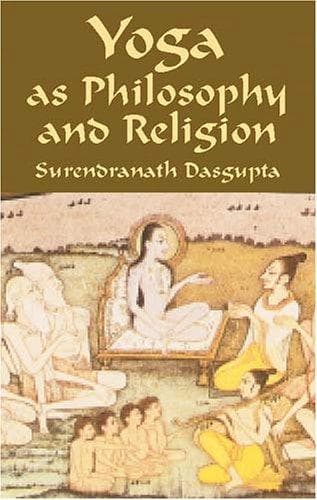
Yoga as philosophy and religionDasgupta, Surendranath
Religion
Yoga as philosophy and religion
Dasgupta, Surendranath
Hindu philosophy; Patañjali; Yoga
These actions, which remove the impurities of the mind, and thus
gradually increase the lustre of knowledge, until the final state of
supreme knowledge is acquired, are called kriyāyoga. They are also
called yogāṅgas, as they help the maturity of the Yoga process by
gradually increasing the lustre of knowledge. They represent the means
by which even an ordinary mind (_vikshiptacitta_) may gradually purify
itself and become fit for the highest ideals of Yoga. Thus the _Bhāshya_
says: “By the sustained practice of these yogāṅgas or accessories of
Yoga is destroyed the fivefold unreal cognition (_avidyā_), which is of
the nature of impurity.” Destruction means here disappearance; thus when
that is destroyed, real knowledge is manifested. As the means of
achievement are practised more and more, so is the impurity more and
more attenuated. And as more and more of it is destroyed, so does the
light of wisdom go on increasing more and more. This process reaches its
culmination in discriminative knowledge, which is knowledge of the
nature of purusha and the guṇas.
CHAPTER XII
THE YOGĀṄGAS
Now the assertion that these actions are the causes of the attainment of
salvation brings up the question of the exact natures of their operation
with regard to this supreme attainment. Bhāshyakara says with respect to
this that they are the causes of the separation of the impurities of the
mind just as an axe is the cause of the splitting of a piece of wood;
and again they are the causes of the attainment of the supreme knowledge
just as dhaṛma is the cause of happiness. It must be remembered that
according to the Yoga theory causation is viewed as mere transformation
of energy; the operation of concomitant causes only removes obstacles
impeding the progress of these transformations in a particular
direction; no cause can of itself produce any effect, and the only way
in which it can help the production of an effect into which the causal
state passes out of its own immanent energy by the principles of
conservation and transformation of energy, is by removing the
intervening obstacles. Thus just as the passage of citta into a happy
state is helped by dharma removing the intervening obstacles, so also
the passage of the citta into the state of attainment of true knowledge
is helped by the removal of obstructions due to the performance of the
yogāṅgas; the necessary obstructions being removed, the citta passes
naturally of itself into this infinite state of attainment of true
knowledge, in which all finitude is merged.
In connection with this, Vyāsa mentions nine kinds of operation of
causes: (1) cause of birth; (2) of preservation; (3) of manifestation;
(4) of modification; (5) knowledge of a premise leading to a deduction;
(6) of otherness; (7) of separation; (8) of attainment; (9) of upholding
(_Vyāsabhāshya_, II. 28.)
Public-domain text, read in full here on John Shaqi.
Reviews
Reviews
No reviews yet
Be the first to share your thoughts on this work.
Elsewhere in the archive
Join the Discussion
Join the discussion
Sign in to leave a comment or review.
Sign InorCreate an account