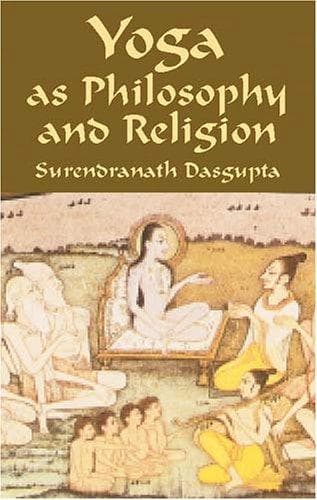
Yoga as philosophy and religionDasgupta, Surendranath
Religion
Yoga as philosophy and religion
Dasgupta, Surendranath
Hindu philosophy; Patañjali; Yoga
The principle of conservation of energy and transformation of energy
being the root idea of causation in this system, these different aspects
represent the different points of view in which the word causation is
generally used.
Thus, the first aspect as the cause of birth or production is seen when
knowledge springs from manas which renders indefinite cognition definite
so that mind is called the cause of the birth of knowledge. Here mind is
the material cause (_upādāna kāraṇa_) of the production of knowledge,
for knowledge is nothing but manas with its particular modifications as
states (_Yoga-vārttika_, II. 18). The difference of these positive cause
from _āptikāraṇa_, which operates only in a negative way and helps
production, in an indirect way by the removal of obstacles, is quite
manifest. The _sthitikāraṇa_ or cause through which things are preserved
as they are, is the end they serve; thus the serviceability of purusha
is the cause of the existence and preservation of the mind as it is, and
not only of mind but of all our phenomenal experiences.
The third cause of the _abhivyaktikāraṇa_ or manifestation which is
compared to a lamp which manifests things before our view is an
epistemological cause, and as such includes all sense activity in
connection with material objects which produce cognition.
Then come the fourth and the fifth causes, vikāra (change) and pratyaya
(inseparable connection); thus the cause of change (_vikāra_) is
exemplified as that which causes a change; thus the manas suffers a
change by the objects presented to it, just as bile changes and digests
the food that is eaten; the cause of pratyaya[41] is that in which from
inseparable connection, with the knowledge of the premise (e.g. there is
smoke in the hill) we can also have inferential knowledge of the other
(e.g. there is fire in the hill). The sixth cause as otherness
(_anyatva_) is that which effects changes of form as that brought about
by a goldsmith in gold when he makes a bangle from it, and then again a
necklace, is regarded as differing from the change spoken of as vikāra.
Now the difference between the gold being turned into bangles or
necklaces and the raw rice being turned into soft rice is this, that in
the former case when bangles are made out of gold, the gold remains the
same in each case, whereas in the case of the production of cooked rice
from raw by fire, the case is different, for heat changes paddy in a far
more definite way; goldsmith and heat are both indeed efficient causes,
but the former only effects mechanical changes of shape and form,
whereas the latter is the cause of structural and chemical changes. Of
course these are only examples from the physical world, their causal
operations in the mental sphere varying in a corresponding manner; thus
the change produced in the mind by the presentation of different
objects, follows a law which is the same as is found in the physical
Public-domain text, read in full here on John Shaqi.
Reviews
Reviews
No reviews yet
Be the first to share your thoughts on this work.
Elsewhere in the archive
Join the Discussion
Join the discussion
Sign in to leave a comment or review.
Sign InorCreate an account