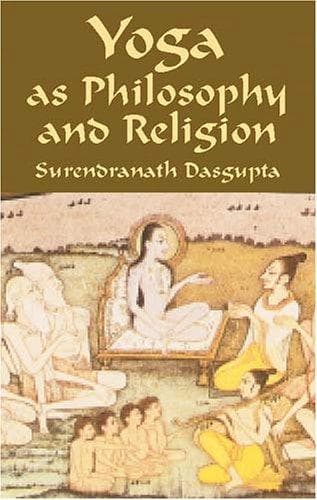
Yoga as philosophy and religionDasgupta, Surendranath
Religion
Yoga as philosophy and religion
Dasgupta, Surendranath
Hindu philosophy; Patañjali; Yoga
world, when the same object causes different kinds of feelings in
different persons; when ignorance causes forgetfulness in a thing, anger
makes it painful and desire makes it pleasurable, but knowledge of its
true reality produces indifference; there is thus the same kind of
causal change as is found in the external world. Next for consideration
is the cause of separation (_viyoga_) which is only a negative aspect of
the positive side of the causes of transformations, as in the gradual
extinction of impurities, consequent upon the transformation of the
citta towards the attainment of the supreme state of absolute
independence through discriminative knowledge. The last cause for
consideration is that of upholding (_dhṛti_); thus the body upholds the
senses and supports them for the actualisation of their activities in
the body, just as the five gross elements are the upholding causes of
organic bodies; the bodies of animals, men, etc., also employ one
another for mutual support. Thus the human body lives by eating the
bodies of many animals; the bodies of tigers, etc., live on the bodies
of men and other animals; many animals live on the bodies of plants,
etc. (_Tattvavaiśāradī_, II. 28). The four kinds of causes mentioned in
Śaṅkara’s works and grammatical commentaries like that of Susheṇa, viz.:
utpādya, vikāryya, āpya and saṃskāryya, are all included within the nine
causes contained mentioned by Vyāsa.
The yogāṅgas not only remove the impurities of the mind but help it
further by removing obstacles in the way of attaining the highest
perfection of discriminative knowledge. Thus they are the causes in a
double sense (1) of the dissociation of impurities (_viyogakāraṇa_); (2)
of removing obstacles which impede the course of the mind in attaining
the highest development (_āptikāraṇa_).
Coming now to the yogāṅgas, we enumerate them thus:—restraint,
observance, posture, regulation of breath, abstraction, concentration,
meditation and trance: these are the eight accessories of Yoga.
It must be remembered that abhyāsa and vairāgya and also the five means
of attaining Yoga, viz.: śraddhā, vīryya, etc., which are not different
from abhyāsa and vairāgya, are by their very nature included within the
yogāṅgas mentioned above, and are not to be considered as independent
means different from them. The parikarmas or embellishments of the mind
spoken of in the first chapter, with which we shall deal later on, are
also included under the three yogāṅgas dhāraṇā, dhyāna and samādhi. The
five means śraddhā, vīryya, smṛti, samādhi and prajñā are said to be
included under asceticism (_tapaḥ_) studies (_svādhyāya_) and devotion
to God of the niyamas and vairāgya in contentment.
In order to understand these better, we will first give the definitions
of the yogāṅgas and then discuss them and ascertain their relative
values for a man striving to attain the highest perfection of Yoga.
Public-domain text, read in full here on John Shaqi.
Reviews
Reviews
No reviews yet
Be the first to share your thoughts on this work.
Elsewhere in the archive
Join the Discussion
Join the discussion
Sign in to leave a comment or review.
Sign InorCreate an account