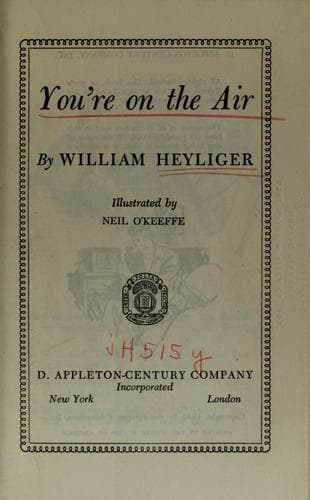
Dramatists -- Juvenile fiction; Radio acting -- Juvenile fiction; Radio broadcasting -- Juvenile fiction
“Joe,” Tony said genially, “I was ready to ship that platter back. We
never know.”
“Nobody?” Joe demanded. Radio was a mad turmoil, but somebody ought to
know.
“Who?” Tony chuckled. “The boys in big time? We guess and they guess.
Amos ’n’ Andy were on sustaining. The station decided the show wasn’t
getting a tumble and took it off. Then came a flood of telephone calls
and letters. On the strength of listener response Amos ’n’ Andy went
back and found a sponsor. They’ve had a sponsor ever since.”
Another platter came in and Joe put it away. Platters and scripts, casts
and producers, sustaining shows and sponsored shows, the
bread-and-butter hunt—it was all mad. When a show came in to be sold,
you never knew what you’d sell. Vic Wylie, with a live cast, had sold
Munson what radio calls “a package”—production, script, and cast. The
whole show. But on _Poisoned Fangs_ the sponsor was buying only script.
Tony would select a new cast and make his own production.
“My first agency show from the beginning,” Joe told himself, and was on
fire to see production start.
No announcement of a new show was made; no hint of a new show appeared
in the radio column of the _Journal_. But almost overnight show people
made Tony’s office a big stop on the rounds.
Laughter, bursts of gaiety, lightened the heavy boom of Tony’s voice.
Show people strolled in leisurely, singly and in pairs. Nobody was in a
hurry, nobody asked about the new show, nobody spoke about a part. This
might have been John Dennis’ office at FKIP the first day Joe had made
the rounds. Bright, sparkling gags. This was a sponsored show; this show
was going to pay money. Sometimes the laughter was a little too eager
and too high.
Joe laughed with them. These gatherings of show people were grand if—he
tried not to look at an actress who kept moistening her rouged lips—if
you could forget that you’d been through it, if you could forget the
courage often required to maintain a front, if you could forget the raw
anxiety behind the mask of gay drollery. Laughter began to hurt.
Mander cocked his hat to one side, did an intricate little step, and
departed alone. But at the door he paused and, glancing back, caught
Joe’s eye significantly. Joe, exploring a pocket for a half-dollar,
joined him.
Mander wasn’t thinking of money. “What show is this?” he asked
hurriedly.
Joe thought: “I’m a kid in this game; he doesn’t think it necessary to
front me.” He said: “Drama. _Poisoned Fangs._ Four characters.”
“Any comedy?”
“A pop-off. Comedy relief.”
“Thanks, Joe; thanks a million.” Somebody else was coming out and Mander
went quickly toward the elevators.
Next day there was another parade of light-hearted gaiety, a new stock
of bright gags. “Did you hear this one, Tony—” But to-day tension was
tighter; it would be tighter to-morrow and still tighter the day after
that. There would be more and more laughter.
Public-domain text, read in full here on John Shaqi.
Reviews
Reviews
No reviews yet
Be the first to share your thoughts on this work.
Elsewhere in the archive
Join the Discussion
Join the discussion
Sign in to leave a comment or review.
Sign InorCreate an account