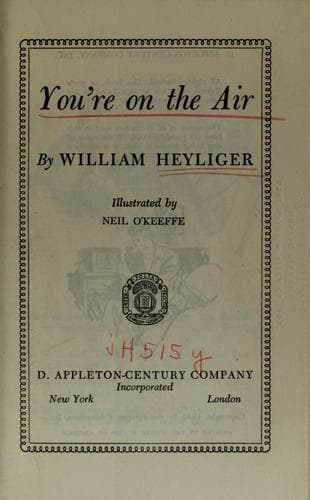
Dramatists -- Juvenile fiction; Radio acting -- Juvenile fiction; Radio broadcasting -- Juvenile fiction
Tony’s voice had changed. “You get used to it. It’s the system; it’s
show business. Will they feel any better if we slam the door on them and
lock them out? Anyway, we’re not guilty of sustaining. When we put on a
show we have a paid cast.”
Joe said slowly: “How long before you’re used to it?”
“I don’t know,” Tony said in that same changed voice. “I’ve been here
only five years.” He went to his desk, wrote for a while, and swung
around with a paper in his hands. “Last year I laid out more than four
hundred dollars in small loans. Most of it’s gone for good. How are they
going to pay back? Where are they going to get it?” He held out the
paper. “Call these people in, Joe. We’ll start to audition.”
Joe, sitting at a telephone, went down the list of calls. Mander at ten
to-morrow morning, somebody else at eleven, somebody else at noon. The
list ran two and one-half days. Fourteen actors and actresses coming
in—and only four parts. Waiting for a number to answer, he thought of
Tony with a stir of emotion. This Tony who boomed and glad-handed wasn’t
the real Tony at all. The boom and the glad hand were front. The real
Tony was as soft-hearted as brooding Vic Wylie.
Mander arrived next morning at ten sharp. Joe thought: “He’s dressed for
the part.” Mander wore a shriekingly loud tie, an exaggerated high
collar, and shoes glaringly yellow. Did this trick of dressing like a
small-town wise guy add anything to a reading? Joe wondered.
“Greetings,” Tony boomed. “Waiting for you.”
“Considering what you’re going to get,” Mander popped off, “you should
have stayed awake all night.” He looked toward Joe and made a blithe
motion with one hand. “A little music, Professor.”
Tony, chewing a cigar, mumbled cues, and Mander read.
And, while the reading went on, the elevators were bringing show people
to the reception-room, and the girl at the desk was telling them that
Tony was busy. That was all they had to be told—they went away. Soon the
news would spread up and down Royal Street that the Tony Vaux show was
cast. By late afternoon the Everts-Hall Agency would no longer be a big
stop.
The reading ended. Tony lit a fresh cigar.
“Let me hear it again, Frank.”
A fine dew of sweat appeared on Mander’s forehead.
“A little too much steam,” Tony said when the second reading was
finished. “Now, now.” Fat hands spread out in a placating gesture. “Not
bad; not bad at all, Frank. But I’m thinking of the other characters.
They’re tense with drama. If you give me high comedy I get too much
contrast. No belly laughs, just chuckles. Take it from ‘I don’t mean I’m
the best in the world—’ Page four.”
There was only a hair-line of change in Mander’s reading, but the part
shaded into an entirely different part. This was what Wylie meant by a
producer touching the strings and producing vibrations. But to give
these vibrations, an actor had to be an actor.
Public-domain text, read in full here on John Shaqi.
Reviews
Reviews
No reviews yet
Be the first to share your thoughts on this work.
Elsewhere in the archive
Join the Discussion
Join the discussion
Sign in to leave a comment or review.
Sign InorCreate an account