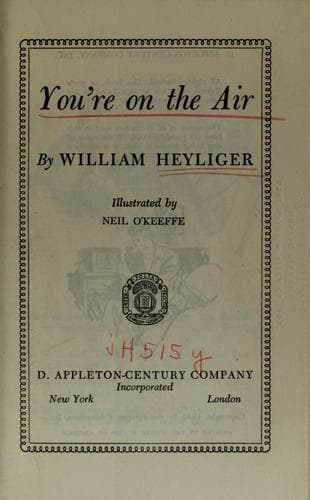
Dramatists -- Juvenile fiction; Radio acting -- Juvenile fiction; Radio broadcasting -- Juvenile fiction
Six words went around and around in Joe’s head: “The best producer in
the city.” His heart was a hammer. Following Wylie, he found himself in
the strangest room he had ever seen, a room that spoke of a
preoccupation which brushed aside as trivial matters that would have
been important to other men. A wide flat desk, that must at one time
have been beautiful, was charred with hundreds of black scars as though
an absorbed man had carelessly laid down lighted cigarettes and then
forgotten them. There was a disordered stack of papers, probably
scripts. There was a lustrous radio as badly cigarette-burned as the
desk. There were dozens of photographs on the walls—autographed
photographs of men and women who were important in radio, in Hollywood,
and on the stage. The cushions of chairs and of a settee, badly scuffed
and lumped out of shape, suggested long hours of feverish argument when
comfort was ignored. But strangest of all was the absence of what had
been the highlight of Amby’s office, a dead, unwired, rehearsal
microphone.
Or was it, Joe wondered, so very strange?
Wylie, from a swivel chair behind the desk, shot out a command. “Give me
your background.”
“Eighteen,” said Joe. “High-school graduate. Four years in high-school
plays. Made the cast my first year.”
“So you’ve decided you’re an actor?”
“I don’t know. I hope I am.”
“Anybody in show business give you any encouragement?”
“Ambrose Carver. He’d heard about me and came to Northend High for the
June play. He told FKIP to call me in for an immediate audition.”
“Who gave you that story? Carver? Is he your agent?”
“Yes.”
“Written contract or verbal agreement?”
“My father signed a contract.”
“All nicely poisoned with legality.” Wylie’s voice was acid. He swung
around in the chair and sat with his back to the room, nervously tense.
Abruptly he swung back as though jerked by invisible wires. “I’m giving
you a chance at something that may never happen. Munson’s store wants a
serial. That’s no secret; everybody in radio knows it.”
Wonder was sharp in Joe. Was that why Amby had known, because everybody
else had known?
The producer went on in a nervous rush of words. “The Everts-Hall Agency
has the Munson account. They haven’t been able to come up with a show
Munson’ll O.K. We’re giving it a whirl. We have our own ideas about the
kind of show Munson should have. A heroine for the lead because a
department store sells mostly to women. A widow fighting to give her son
a chance in life. _Sue Davis Against the World_. You’re Dick Davis, the
son. You’re fifteen. You want to get out of school and help.” Wylie
tossed a script across the desk. “Page four. Read me the speech
beginning ‘Mother, don’t shake your head....’” The chair swung again and
the man’s back was to the room.
Joe Carlin found the place. Joe Carlin, who was becoming a veteran, who
had had three station auditions, who had rehearsed a show and cut a
platter for FKIP began to read:
Dick: Mother, don’t shake—
Public-domain text, read in full here on John Shaqi.
Reviews
Reviews
No reviews yet
Be the first to share your thoughts on this work.
Join the Discussion
Join the discussion
Sign in to leave a comment or review.
Sign InorCreate an account