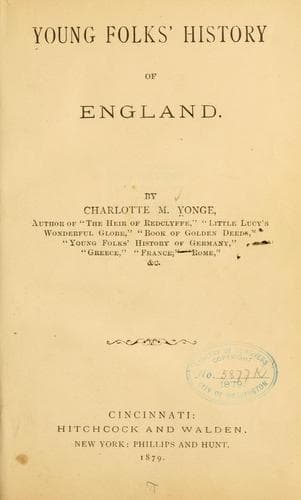
Young Folks' History of EnglandYonge, Charlotte M. (Charlotte Mary)
History
Young Folks' History of England
Yonge, Charlotte M. (Charlotte Mary)
Great Britain -- History -- Juvenile literature
Just after George III. came to the crown, a great war broke out in the
English colonies in America. A new tax had been made. A tax means
the money that has to be given to the Government of a country to pay
the judges and their officers, the soldiers and sailors, to keep up
ships and buy weapons, and do all that is wanted to protect us and
keep us in order. Taxes are sometimes made by calling on everybody to
pay money in proportion to what they have--say threepence for every
hundred pounds; sometimes they are made by putting what is called a
duty on something that is bought and sold--making it sell for more
than its natural price--so that the Government gets the money above
the right cost. This is generally done with things that people could
live without, and had better not buy too much of--such as spirits,
tobacco, and hair powder. And as tea was still a new thing in England,
which only fine ladies drank, it was thought useless, and there was a
heavy duty laid upon it when the king wanted money. Now, the Americans
got their tea straight from China, and thought it was unfair that they
should pay tax on it. So, though they used it much more than the
English then did, they gave it up, threw whole ship-loads of it into
the harbor at Boston, and resisted the soldiers. A gentleman named
George Washington took the command, and they declared they would fight
for freedom from the mother country. The French were beginning to
think freedom was a fine thing, and at first a few French gentlemen
came over to fight among the Americans, and then the king Louis XVI.,
quarreled with George III., and helped them openly.
There was a very clever man among the Americans named Benjamin
Franklin, a printer by trade, but who made very curious discoveries.
One of them was that lightning comes from the strange power men call
electricity, and that there are some substances which it will run
along, so that it came be brought down to the ground without doing any
mischief--especially metallic wires. He made sure of it by flying a
kite, with such an iron wire up to the clouds when there was a thunder-
storm. The lightning was attracted by the wire, ran down the wet
string of the kite, and only glanced off when it came to a silk ribbon
--because electricity will not go along silk. After this, such wires
were fastened to buildings, and carried down into the ground, to
convey away the force of the lightning. Perhaps you have seen them
on the tops of churches or tall buildings; they are called conductors.
Franklin was a plain-spoken, homely dressing man; and when he was sent
to Paris on the affairs of the Americans, all the great ladies and
gentlemen went into raptures about his beautiful simplicity, and began
to imitate him, in a very affected, ridiculous way.
Public-domain text, read in full here on John Shaqi.
Reviews
Reviews
No reviews yet
Be the first to share your thoughts on this work.
Elsewhere in the archive
Join the Discussion
Join the discussion
Sign in to leave a comment or review.
Sign InorCreate an account