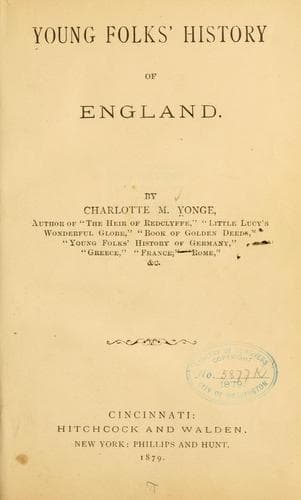
Young Folks' History of EnglandYonge, Charlotte M. (Charlotte Mary)
History
Young Folks' History of England
Yonge, Charlotte M. (Charlotte Mary)
Great Britain -- History -- Juvenile literature
These servants of the king used to flatter him. They told him he was
lord of land and sea, and that every thing would obey him. "Let us
try," said Cnut, who wished to show them how foolish and profane they
were; "bring out my chair to the sea-side." He was at Southampton at
the time, close to the sea, and the tide was coming in. "Now sea," he
said, as he sat down, "I am thy lord, dare not to come near, nor wet
my feet." Of course the waves rolled on, and splashed over him; and
he turned to his servants, and bade them never say words that took
away from the honor due to the only Lord of heaven and earth. He
never put on his crown again after this, but hung it up in Winchester
Cathedral. He was a thorough good king, and there was much grief when
he died, stranger though he was.
A great many Danes had made their homes in Yorkshire and Lincolnshire,
ever since Alfred's time, and some of their customs are still left
there, and some of their words. The worst of them was that they were
great drunkards, and the English learnt this bad custom of them.
CHAPTER VI.
THE NORMAN CONQUEST. A.D. 1035--1066.
Cnut left three sons; but one was content to be only King of Denmark,
and the other two died very soon. So a great English nobleman, called
Earl Godwin, set up as king, Edward, one of those sons of Ethelred the
Unready who had been sent away to Normandy. He was a very kind, good,
pious man, who loved to do good. He began the building of our grand
church at Westminster Abbey, and he was so holy that he was called the
Confessor, which is a word for good men not great enough to be called
saints. He was too good-natured, as you will say when you hear that
one day, when he was in bed, he saw a thief come cautiously into his
room, open the chest where his treasure was, and take out the money-
bags. Instead of calling anyone, or seizing the man, the king only
said, sleepily, "Take care, you rogue, or my chancellor will catch
you and give you a good whipping."
You can fancy that nobody much minded such a king as this, and so
there were many disturbances in his time. Some of them rose out of
the king--who had been brought up in Normandy--liking the Normans
better than the English. They really were much cleverer and more
sensible, for they had learnt a great deal in France, while the
English had forgotten much of what Alfred and his sons had taught
them, and all through the long, sad reign of Ethelred had been getting
more dull, and clumsy and rude. Moreover, they had learnt of the Danes
to be sad drunkards; but both they and the Danes thought the Norman
French fine gentlemen, and could not bear the sight of them.
Public-domain text, read in full here on John Shaqi.
Reviews
Reviews
No reviews yet
Be the first to share your thoughts on this work.
Join the Discussion
Join the discussion
Sign in to leave a comment or review.
Sign InorCreate an account