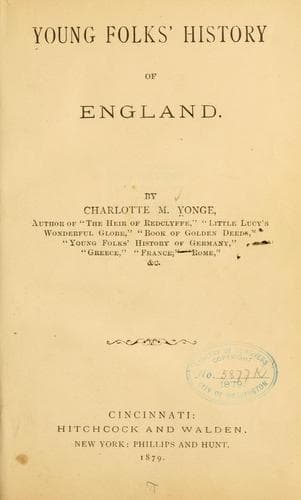
Young Folks' History of EnglandYonge, Charlotte M. (Charlotte Mary)
History
Young Folks' History of England
Yonge, Charlotte M. (Charlotte Mary)
Great Britain -- History -- Juvenile literature
Think, then, how angry they all were when it began to be said that King
Edward wanted to leave his kingdom of England to his mother's Norman
nephew, Duke William, because all his own near relations were still
little boys, not likely to be grown up by the time the old king died.
Many of the English wished for Harold, the son of Earl Godwin, a brave,
spirited man; but Edward sent him to Normandy, and there Duke William
made him swear an oath not to do anything to hinder the kingdom from
being given to Duke William.
Old King Edward died soon after, and Harold said at once that his
promise had been forced and cheated from him, so that he need not
keep it, and he was crowned King of England. This filled William
with anger. He called all his fighting Normans together, fitted
out ships, and sailed across the English Channel to Dover. The
figure-head of his own ship was a likeness of his second little boy,
named William. He landed at Pevensey, in Sussex, and set up his camp
while Harold was away in the North, fighting with a runaway brother
of his own, who had brought the Norwegians to attack Yorkshire.
Harold had just won a great battle over these enemies when he heard
that William and his Normans had landed, and he had to hurry the
whole length of England to meet them.
Many of the English would not join him, because they did not want him
for their king. But though his army was not large, it was very brave.
When he reached Sussex, he placed all his men on the top of a low hill,
near Hastings, and caused them to make a fence all round, with a ditch
before it, and in the middle was his own standard, with a fighting man
embroidered upon it. Then the Normans rode up on their war-horses to
attack him, one brave knight going first, singing. The war-horses
stumbled in the ditch, and the long spears of the English killed both
men and horses. Then William ordered his archers to shoot their
arrows high in the air. They came down like hail into the faces and
on the heads of the English. Harold himself was pierced by one in the
eye. The Normans charged the fence again, and broke through; and, by
the time night came on, Harold himself and all his brave Englishmen
were dead. They did not flee away; they all staid, and were killed,
fighting to the last; and only then was Harold's standard of the
fighting man rooted up, and William's standard--a cross, which had
been blessed by the Pope--planted instead of it. So ended the battle
of Hastings, in the year 1066.
The land has had a great many "conquests" hitherto--the Roman conquest,
the English conquest, and now the Norman conquest. But there have
been no more since; and the kings and queens have gone on in one long
line ever since, from William of Normandy down to Queen Victoria.
CHAPTER VII.
WILLIAM THE CONQUEROR. A.D. 1066--1087.
The king who had conquered England was a brave, strong man, who had
been used to fighting and struggling ever since he was a young child.
Public-domain text, read in full here on John Shaqi.
Reviews
Reviews
No reviews yet
Be the first to share your thoughts on this work.
Join the Discussion
Join the discussion
Sign in to leave a comment or review.
Sign InorCreate an account