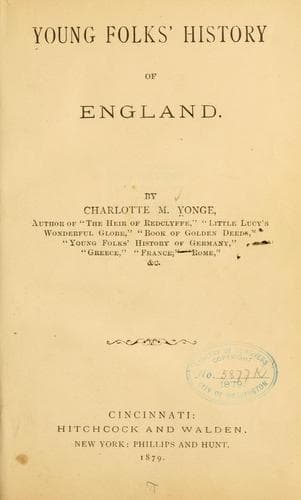
Young Folks' History of EnglandYonge, Charlotte M. (Charlotte Mary)
History
Young Folks' History of England
Yonge, Charlotte M. (Charlotte Mary)
Great Britain -- History -- Juvenile literature
When they
grumbled, he worked with them, and asked the duke to do the same; but
Leopold said gruffly that he was not a carpenter or a mason. Richard
was so provoked that he struck him a blow, and the duke went home in
a rage.
So many men had gone home, that Richard found his army was not strong
enough to try to take Jerusalem. He was greatly grieved, for he knew
it was his own fault for not having shown the temper of a Crusader;
and when he came to the top of a hill whence the Holy City could be
seen, he would not look at it, but turned away, saying, "They who are
not worthy to win it are not worthy to behold it." It was of no use
for him to stay with so few men; besides, tidings came from home that
King Philip and his own brother, John, were doing all the mischief
they could. So he made a peace for three years between the Saracens
and Christians, hoping to come back again after that to rescue
Jerusalem. But on his way home there were terrible storms; his ships
were scattered, and his own ship was driven up into the Adriatic Sea,
where he was robbed by pirates, or sea robbers, and then was
shipwrecked. There was no way for him to get home but through the
lands of Leopold of Austria; so he pretended to be a merchant, and
set out attended only by a boy. He fell ill at a little inn, and
while he was in bed the boy went into the kitchen with the king's
glove in his belt. It was an embroidered glove, such as merchants
never used, and people asked questions, and guessed that the boy's
master must be some great man. The Duke of Austria heard of it,
sent soldiers to take him, and shut him up as a prisoner in one of
his castles. Afterwards, the duke gave him up for a large sum of
money to the Emperor of Germany. All this time Richard's wife and
mother had been in great sorrow and fear, trying to find out what
had become of him. It is said that he was found at last by his
friend, the minstrel Blondel. A minstrel was a person who made
verses and sang them. Many of the nobles and knights in Queen
Eleanor's Duchy of Aquitaine were minstrels--and Richard was a very
good one himself, and amused himself in his captivity by making
verses. This is certainly true--though I cannot answer for it that
the pretty story is true, which says that Blondel sung at all the
castle courts in Germany, till he heard his master's voice take up
and reply to his song.
The Queens, Eleanor and Berengaria, raised a ransom--that is, a sum
of money to buy his freedom--though his brother John tried to prevent
them, and the King of France did his best to hinder the emperor from
releasing him; but the Pope insisted that the brave crusader should
be set at liberty: and Richard came home, after a year and a half of
captivity. He freely forgave John for all the mischief he had done
or tried to do, though he thought so ill of him as to say, "I wish
I may forget John's injuries to me as soon as he will forget my pardon
of him."
Public-domain text, read in full here on John Shaqi.
Reviews
Reviews
No reviews yet
Be the first to share your thoughts on this work.
Join the Discussion
Join the discussion
Sign in to leave a comment or review.
Sign InorCreate an account