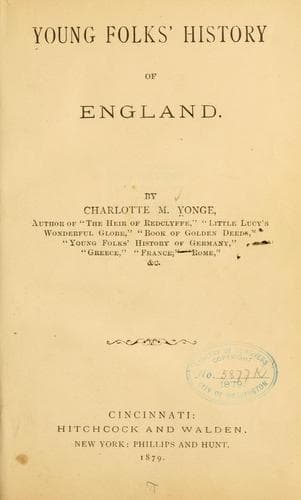
Young Folks' History of EnglandYonge, Charlotte M. (Charlotte Mary)
History
Young Folks' History of England
Yonge, Charlotte M. (Charlotte Mary)
Great Britain -- History -- Juvenile literature
Richard only lived two years after he came back. He was besieging a
castle in Aquitaine, where there was some treasure that he thought was
unlawfully kept from him, when he was struck in the shoulder by a bolt
from a cross-bow, and the surgeons treated it so unskilfully that in
a few days he died. The man who had shot the bolt was made prisoner,
but the Lion-heart's last act was to command that no harm should be
done to him. The soldiers, however, in their grief and rage for the
king, did put him to death in a cruel manner.
Richard desired to be burned at the feet of his father, in Fontevraud
Abbey, where he once bewailed his undutiful conduct, and now wished
his body forever to lie in penitence. The figures in stone, of the
father, mother, and son, who quarreled so much in life, all lie on
one monument now, and with them Richard's youngest sister Joan, who
died nearly at the same time as he died, party of grief for him.
CHAPTER XIII.
JOHN, LACKLAND. A.D. 1199--1216.
As a kind of joke, John, King Henry's youngest son, had been called
Lackland, because he had nothing when his brothers each had some great
dukedom. The name suited him only too well before the end of his life.
The English made him king at once. They always did take a grown-up
man for their king, if the last king's son was but a child. Richard
had never had any children, but his brother Geoffrey, who was older
than John, had left a son named Arthur, who was about twelve years
old, and who was rightly the Duke of Normandy and Count of Anjou.
King Philip, who was always glad to vex whoever was king of England,
took Arthur under his protection, and promised to get Normandy out of
John's hands. However, John had a meeting with him and persuaded him
to desert Arthur, and marry his son Louis to John's own niece, Blanche,
who had a chance of being queen of part of Spain. Still Arthur lived
at the French King's court, and when he was sixteen years old, Philip
helped him to raise an army and go to try his fortune against his
uncle. He laid siege to Mirabeau, a town where his grandmother, Queen
Eleanor, was living. John, who was then in Normandy, hurried to her
rescue, beat Arthur's army, made him prisoner and carried him off,
first to Rouen, and then to the strong castle of Falaise. Nobody
quite knows what was done to him there. The governor, Hubert de
Burgh, once found him fighting hard, though with no weapon but a
stool, to defend himself from some ruffians who had been sent to put
out his eyes. Hubert saved him from these men, but shortly after
this good man was sent elsewhere by the king, and John came himself
to Falaise. Arthur was never seen alive again, and it is believed
that John took him out in a boat in the river at night, stabbed him
with his own hand, and threw his body into the river. There was, any
way, no doubt that John was guilty of his nephew's death, and he was
fully known to be one of the most selfish and cruel men who ever
Public-domain text, read in full here on John Shaqi.
Reviews
Reviews
No reviews yet
Be the first to share your thoughts on this work.
Join the Discussion
Join the discussion
Sign in to leave a comment or review.
Sign InorCreate an account