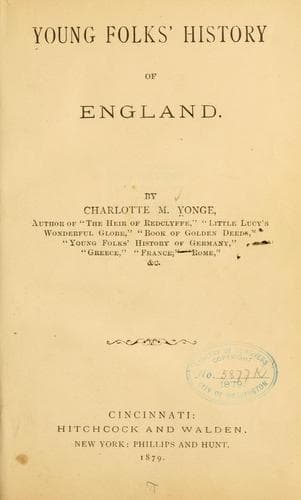
Young Folks' History of EnglandYonge, Charlotte M. (Charlotte Mary)
History
Young Folks' History of England
Yonge, Charlotte M. (Charlotte Mary)
Great Britain -- History -- Juvenile literature
But he did not mean to keep it! No, not he! He had one of his
father's fits of rage when he got back to Windsor Castle--he gnawed
the sticks for rage and swore he was no king. Then he sent for more
of the fierce soldiers, who went about in bands, ready to be hired,
and prepared to take vengeance on the barons. They found themselves
not strong enough to make head against him; so they invited Louis, the
son of Philip of France and husband of John's niece, to come and be
their king. He came, and was received in London, while John and his
bands of soldiers were roaming about the eastern counties, wasting
and burning everywhere till they came to the Wash--that curious bay
between Lincolnshire and Norfolk, where so many rivers run into the
sea. There is a safe way across the sands in this bay when the tide
is low, but when it is coming in and meets the rivers, the waters
rise suddenly into a flood. So it happened to King John; he did get
out himself, but all carts with his goods and treasures were lost,
and many of his men. He was full of rage and grief, but he went on
to the abbey where he meant to sleep. He supped on peaches and new
ale, and soon after became very ill. He died in a few days, a
miserable, disgraced man, with half his people fighting against him
and London in the hands of his worst enemy.
CHAPTER XIV.
HENRY III., OF WINCHESTER. A.D. 1216--1272.
King John left two little sons, Henry and Richard, nine and seven
years old, and all the English barons felt that they would rather
have Henry as their king than the French Louis, whom they had only
called in because John was such a wretch. So when little Henry had
been crowned at Gloucester, with his mother's bracelet, swearing to
rule according to Magna Carta, and good Hubert de Burgh undertook to
govern for him, one baron after another came back to him. Louis was
beaten in a battle at Lincoln; and when his wife sent him more troops,
Hubert de Burgh got ships together and sunk many vessels, and drove
the others back in the Straits of Dover; so that Louis was forced to
go home and leave England in peace.
Henry must have been too young to understand about Magna Carta when
he swore to it, but it was the trouble of all his long reign to get
him to observe it. It was not that he was wicked like his father--
for he was very religious and kind-hearted--but he was too good-
natured, and never could say No to anybody. Bad advisers got about
him when he grew up, and persuaded him to let them take good Hubert
de Burgh and imprison him. He had taken refuge in a church, but they
dragged him out and took him to a blacksmith to have chains put on his
feet; the smith however said he would never forge chains for the man
who had saved his country from the French. De Burgh was afterwards
set free, and died in peace and honor.
Public-domain text, read in full here on John Shaqi.
Reviews
Reviews
No reviews yet
Be the first to share your thoughts on this work.
Join the Discussion
Join the discussion
Sign in to leave a comment or review.
Sign InorCreate an account