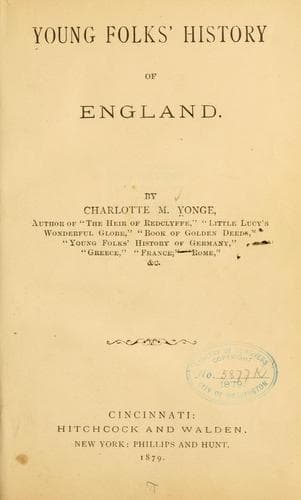
Young Folks' History of EnglandYonge, Charlotte M. (Charlotte Mary)
History
Young Folks' History of England
Yonge, Charlotte M. (Charlotte Mary)
Great Britain -- History -- Juvenile literature
Henry was a builder of beautiful churches. Westminster Abbey, as it
is now, was one. And he was so charitable to the poor that, when he
had his children weighed, he gave their weight in gold and silver in
alms. But he gave to everyone who asked, and so always wanted money;
and sometimes his men could get nothing for the king and queen to eat,
but by going and taking sheep and poultry from the poor farmers around;
so that things were nearly as bad as under William Rufus--because the
king was foolishly good-natured. The Pope was always sending for
money, too; and the king tried to raise it in ways that, according to
Magna Carta, he had sworn not to do. His foreign friends told him
that if he minded Magna Carta he would be a poor creature--not like
a king who might do all he pleased; and whenever he listened to them
he broke the laws of Magna Carta. Then, when his barons complained
and frightened him, he swore again to keep them; so that nobody could
trust him, and his weakness was almost as bad for the kingdom as John's
wickedness. When they could bear it no longer, the barons all met him
at the council which was called the Parliament, from a French word
meaning talk. This time they came in armor, bringing all their
fighting men, and declared that he had broken his word so often that
they should appoint some of their own number to watch him, and hinder
his doing anything against the laws he had sworn to observe, or from
getting money from the people without their consent. He was very
angry; but he was in their power, and had to submit to swear that
so it should be; and Simon de Montfort, Earl of Leicester, who had
married his sister, was appointed among the lords who were to keep
watch over him. Henry could not bear this; he felt himself to be
less than ever a king, and tried to break loose. He had never cared
for his promises; but his brave son Edward, who was now grown up,
cared a great deal: and they put the question to Louis, King of France,
whether the king was bound by the oath he had made to be under
Montfort and his council. This Louis was son to the one who had been
driven back by Hubert de Burgh. He was one of the best men and kings
that ever lived, and he tried to judge rightly; but he scarcely thought
how much provocation Henry had given, when he said that subjects had
no right to frighten their king, and so that Henry and Edward were
not obliged to keep the oath.
Thereupon they got an army together, and so did Simon de Montfort and
the barons; and they met at a place called Lewes, in Sussex. Edward
got the advantage at first, and galloped away, driving his enemies
before him; but when he turned round and came back, he found that
Simon de Montfort had beaten the rest of the army, and made his father
and uncle Richard prisoners. Indeed, the barons threatened to cut off
Richard's head if Edward went on fighting with them; and to save his
uncle's life, he too, gave himself up to them.
Public-domain text, read in full here on John Shaqi.
Reviews
Reviews
No reviews yet
Be the first to share your thoughts on this work.
Join the Discussion
Join the discussion
Sign in to leave a comment or review.
Sign InorCreate an account