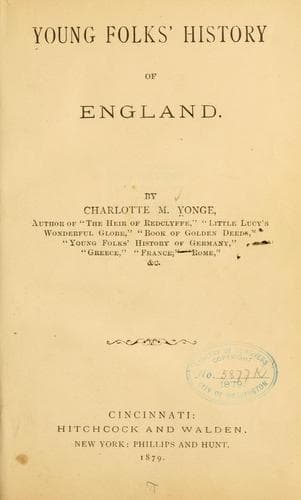
Young Folks' History of EnglandYonge, Charlotte M. (Charlotte Mary)
History
Young Folks' History of England
Yonge, Charlotte M. (Charlotte Mary)
Great Britain -- History -- Juvenile literature
Simon de Montfort now governed all the kingdom. He still called Henry
king, but did not let him do anything, and watched him closely that
he might not get away; and Edward was kept a prisoner--first in one
castle, then in another. Simon was a good and high-minded man
himself, who only wanted to do what was best for everyone; but he had
a family of proud and overbearing sons, who treated all who came in
their way so ill, that most of the barons quarreled with them. One
of these barons sent Edward a beautiful horse; and one day when he
was riding out from Hereford Castle with his keepers, he proposed to
them to ride races, while he was to look on and decide which was the
swiftest. Thus they all tired out their horses, and as soon as he
saw that they could hardly get them along, Edward spurred his own
fresh horse, and galloped off to meet the friends who were waiting
for him. All who were discontented with the Montforts joined him,
and he soon had a large army. He marched against Montfort, and met
him at Evesham. The poor old king was in Montfort's army, and in
the battle was thrown down, and would have been killed if he had not
called out--"Save me, save me, I am Henry of Winchester." His son
heard the call, and, rushing to his side, carried him to a place of
safety. His army was much the strongest, and Montfort had known from
the first that there was no hope for him. "God have mercy on our
souls, for our bodies are Sir Edward's," he had said; and he died
bravely on the field of battle.
Edward brought his father back to reign in all honor, but he took the
whole management of the kingdom, and soon set things in order again--
taking care that Magna Carta should be properly observed. When
everything was peaceful at home, he set out upon a Crusade with the
good King of France, and while he was gone his father died, after a
reign of fifty-six years. There only three English Kings who reigned
more than fifty years, and these are easy to remember, as each was the
third of his name--Henry III., Edward III., and George III. In the
reign of Henry III. the custom of having Parliaments was established,
and the king was prevented from getting money from the people unless
the Parliament granted it. The Parliament has, ever since, been made
up of great lords, who are born to it: and, besides them, of men
chosen by the people in the counties and towns, to speak and decide
for them. The clergy have a meeting of their own called Convocation;
and these three--Clergy, Lords, and Commons--are called the Three
Estates of the Realm.
CHAPTER XV.
EDWARD I., LONGSHANKS. A.D. 1272--1307.
Public-domain text, read in full here on John Shaqi.
Reviews
Reviews
No reviews yet
Be the first to share your thoughts on this work.
Join the Discussion
Join the discussion
Sign in to leave a comment or review.
Sign InorCreate an account