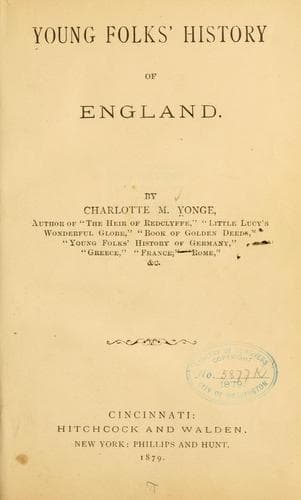
Young Folks' History of EnglandYonge, Charlotte M. (Charlotte Mary)
History
Young Folks' History of England
Yonge, Charlotte M. (Charlotte Mary)
Great Britain -- History -- Juvenile literature
These were not very good times in England. The new King, Richard, was
only eleven years old, and his three uncles did not care much for his
good or the good of the nation. There was not much fighting going on
in France, but for the little there was a great deal of money was
wanting, and the great lords were apt to be very hard upon the poor
people on their estates. They would not let them be taught to read;
and if a poor man who belonged to an estate went away to a town, his
lord could have him brought back to his old home. Any tax, too, fell
more heavily on the poor than the rich. One tax, especially, called
the poll tax, which was made when Richard was sixteen, vexed them
greatly. Everyone above fifteen years old had to pay fourpence, and
the collectors were often very rude and insolent. A man named Wat
Tyler, in Kent, was so angry with a rude collector as to strike him
dead. All the villagers came together with sticks, scythes, and
flails; and Wat Tyler told them they would go to London, and tell the
king how his poor commons were treated. More people and more joined
them on the way, and an immense multitude of wild looking men came
pouring into London, where the Lord Mayor and Aldermen were taken by
surprise, and could do nothing to stop them. They did not do much
harm then; they lay on the grass all night round the Tower, and said
they wanted to speak to the king. In the morning he came down to his
barge, and meant to have spoken to them; but his people, seeing such
a host of wild men, took fright, and carried him back again. He went
out again the next day on horseback; but while he was speaking to some
of them, the worst of them broke into the Tower, where they seized
Archbishop Simon of Canterbury, and fancying he was one of the king's
bad advisers, they cut off his head. Richard had to sleep in the
house called the Royal Wardrobe that night, but he went out again on
horseback among the mob, and began trying to understand what they
wanted. Wat Tyler, while talking, grew violent, forgot to whom he
was speaking, and laid his hand on the king's bridle, as if to
threaten or take him prisoner. Upon this, the Lord Mayor, with his
mace--the large crowned staff that is carried before him--dealt the
man such a blow that fell from his horse, and an attendant thrust him
through with a sword. The people wavered, and seemed not to know
what to do: and the young king, with great readiness, rode forward
and said--"Good fellows, have you lost your leader? This fellow was
but a traitor, I am your king, and will be your captain and guide."
Then he rode at their head out into the fields, and the gentlemen,
who had mustered their men by this time, were able to get between
them and the city. The people of each county were desired to state
their grievances; the king engaged to do what he could for them, and
they went home.
Public-domain text, read in full here on John Shaqi.
Reviews
Reviews
No reviews yet
Be the first to share your thoughts on this work.
Join the Discussion
Join the discussion
Sign in to leave a comment or review.
Sign InorCreate an account