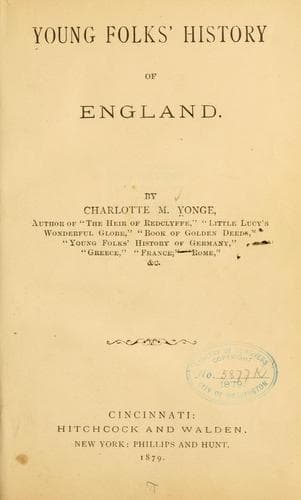
Young Folks' History of EnglandYonge, Charlotte M. (Charlotte Mary)
History
Young Folks' History of England
Yonge, Charlotte M. (Charlotte Mary)
Great Britain -- History -- Juvenile literature
Richard seems to have really wished to take away some of the laws that
were so hard upon them, but his lords would not let him, and he had as
yet very little power--being only a boy--and by the time he grew up
his head was full of vanity and folly. He was very handsome, and he
cared more for fine clothes and amusements than for business; and his
youngest uncle, the Duke of Gloucester, did all he could to keep him
back, and hinder him from taking his affairs into his own hands. Not
till he was twenty-four did Richard begin to govern for himself; and
then the Duke of Gloucester was always grumbling and setting the
people to grumble, because the king chose to have peace with France.
Duke Thomas used to lament over the glories of the battles of Edward
III., and tell the people they had taxes to pay to keep the king in
ermine robes, and rings, and jewels, and to let him give feasts and
tilting matches--when the knights, in beautiful, gorgeous armor, rode
against one another in sham fight, and the king and ladies looked on
and gave the prize.
Now, Richard knew very well that all this did not cost half so much as
his grandfather's wars, and he said it did not signify to the people
what he wore, or how he amused himself, as long as he did not tax them
and take their lambs and sheaves to pay for it. But the people would
not believe him, and Gloucester was always stirring them up against
him, and interfering with him in council. At last, Richard went as
if on a visit to his uncle at Pleshy Castle; and there, in his own
presence, caused him to be seized and sent off to Calais. In a few
days' time Thomas, Duke of Gloucester, was dead; and to this day
nobody knows whether his grief and rage brought on a fit, or if he
was put to death. It is certain, at least, that Richard's other two
uncles do not seem to have treated the king as if he had been to
blame. The elder of these uncles, the Duke of Lancaster, was called
John of Gaunt--because he had been born a Ghent, a town in Flanders.
He was becoming an old man, and only tried to help the king and keep
things quiet; but Henry, his eldest son, was a fine high-spirited
young man--a favorite with everybody, and was always putting himself
forward--and the king was very much afraid of him.
Public-domain text, read in full here on John Shaqi.
Reviews
Reviews
No reviews yet
Be the first to share your thoughts on this work.
Join the Discussion
Join the discussion
Sign in to leave a comment or review.
Sign InorCreate an account