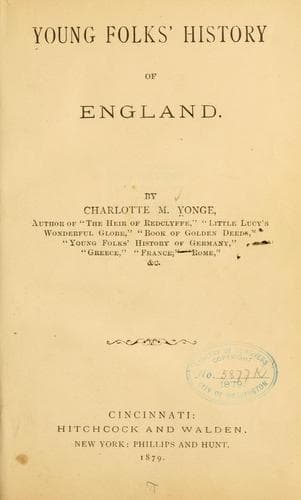
Young Folks' History of EnglandYonge, Charlotte M. (Charlotte Mary)
History
Young Folks' History of England
Yonge, Charlotte M. (Charlotte Mary)
Great Britain -- History -- Juvenile literature
All Oliver Cromwell's army was broken up, and the men sent to their
homes, except one regiment which came from Coldstream in Scotland.
These would not disband, and when Charles II. heard it he said he
would take them as his guards. This was the beginning of there
being always a regular army of men, whose whole business it is to
be soldiers, instead of any man being called from his work when he
is wanted.
Charles II. promised pardon to all the rebels, but he did try and
execute all who had been actually concerned in condemning his father
to death.
CHAPTER XXXVII.
CHARLES II. A.D. 1660-1685.
It is sad to have to say that, after all his troubles, Charles II.
disappointed everybody. Some of these disappointments could not be
helped, but others were his own fault. The Puritan party thought,
after they had brought him home again he should have been more
favorable to them, and grumbled at the restoration of the clergymen
and of the Prayer-book. The Cavaliers thought that, after all they
had gone through for him and his father, he ought to have rewarded
them more; but he said truly enough, that if he had made a nobleman
of everyone who had deserved well of him, no place but Salisbury Plain
would have been big enough for the House of Lords to meet upon. Then
those gentlemen who had got into debt to raise soldiers for the king's
service, and had paid fines, or had to sell their estates, felt it
hard not to have them again; but when a Roundhead gentleman had
honestly bought the property, it would have been still more unjust
to turn them out. These two old names of Cavaliers and Roundheads
began to turn into two others even more absurd. The Cavalier set
came to be called Tories, an Irish name for a robber, and the Puritans
got the Scotch name of Whigs, which means buttermilk.
It would have taken a very strong, wise, and good man to deal rightly
with two such different sets of people; but though Charles II. was a
very clever man, he was neither wise nor good. He could not bear to
vex himself, nor anybody else; and, rather than be teased, would grant
almost anything that was asked of him. He was so bright and lively,
and made such droll, good-natured answers, that everyone liked him who
came near him; but he had no steady principle, only to stand easy with
everybody, and keep as much power for himself as he could without giving
offence. He loved pleasure much better than duty, and kept about him
a set of people who amused him, but were a disgrace to his court.
They even took money from the French king to persuade Charles against
helping the Dutch in their war against the French. The Dutch went to
war with the English upon this, and there were many terrible sea-
fights, in which James, Duke of York, the king's brother, shewed
himself a good and brave sailor.
Public-domain text, read in full here on John Shaqi.
Reviews
Reviews
No reviews yet
Be the first to share your thoughts on this work.
Elsewhere in the archive
Join the Discussion
Join the discussion
Sign in to leave a comment or review.
Sign InorCreate an account