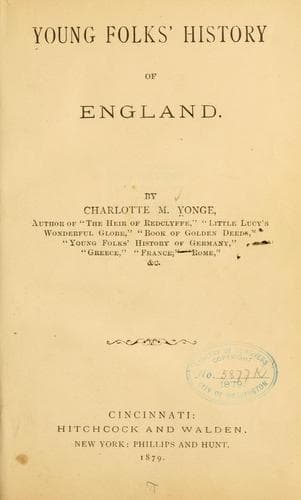
Young Folks' History of EnglandYonge, Charlotte M. (Charlotte Mary)
History
Young Folks' History of England
Yonge, Charlotte M. (Charlotte Mary)
Great Britain -- History -- Juvenile literature
The year 1665 is remembered as that in which there was a dreadful
sickness in London, called the plague. People died of it often after
a very short illness, and it was so infectious that it was difficult
to escape it. When a person in a house was found to have it, the door
was fastened up and marked with a red cross in chalk, and no one was
allowed to go out or in; food was set down outside to be fetched in,
and carts came round to take away the dead, who were all buried
together in long ditches. The plague was worst in the summer and
autumn; as winter came on more recovered and fewer sickened, and
at last this frightful sickness was ended; and by God's good mercy,
it has never since that year come to London.
The next year 1666, there was a fire in London, which burnt down whole
streets, with their churches, and even destroyed St. Paul's Cathedral.
Perhaps it did good by burning down the dirty old houses and narrow
streets where the plague might have lingered, but it was a fearsome
misfortune. It was only stopped at last by blowing up a space with
gunpowder all round it, so that the flames might have no way to pass
on. The king and his brother came and were very helpful in giving
orders about this, and in finding shelter for many poor, homeless
people.
There was a good deal of disturbance in Scotland when the king wanted
to bring back the bishops and the Prayer-book. Many of the Scots
would not go to church, and met on hills and moors to have their
prayers in their own way. Soldiers were sent to disperse them, and
there was much fierce, bitter feeling. Archbishop Sharpe was dragged
out of his carriage and killed, and then there was a civil war, in
which the king's men prevailed; but the Whigs were harshly treated,
and there was great discontent.
The country was much troubled because the king and queen had no
children: and the Duke of York was a Roman Catholic. A strange story
was got up that there was what was called a popish plot for killing
the king, and putting James on the throne. Charles himself laughed at
it, for he knew everyone liked him and disliked his brother: "No one
would kill me to make you king, James," he said; but in his easy,
selfish way, when he found that all the country believed in it, and
wanted to have the men they fancied guilty put to death, he did not
try to save their lives.
Public-domain text, read in full here on John Shaqi.
Reviews
Reviews
No reviews yet
Be the first to share your thoughts on this work.
Elsewhere in the archive
Join the Discussion
Join the discussion
Sign in to leave a comment or review.
Sign InorCreate an account