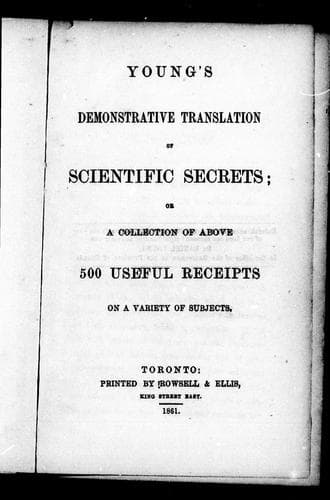
Young's Demonstrative Translation of Scientific Secrets: Or, A Collection of Above 500 Useful Receipts on a Variety of SubjectsYoung, Daniel
Science
Young's Demonstrative Translation of Scientific Secrets: Or, A Collection of Above 500 Useful Receipts on a Variety of Subjects
Young, Daniel
Formulas, recipes, etc.; Science -- Methodology
For 1 lb. of yard or cloth, take 3 ozs. of madder; 3 ozs. of alum;
1 oz. of cream tartar; prepare a brass kettle with two gallons of
water, and bring the liquor to a steady heat, then add your alum and
tartar, and bring it to a boil; put in your cloth, and boil it two
hours; take it out, and rinse it in cold water; empty your kettle,
and fill it with as much water as before; then add your madder; rub
it in fine in the water before your cloth is in. When your dye is
as warm as you can bear your hand in, then put in your cloth, and
let it lie one hour, and keep a steady heat; keep it in motion
constantly, then bring it to a boil fifteen minutes, then air and
rinse it. If your goods are new, use 4 ozs. of madder to a lb.
212. TO COLOUR GREEN
If you wish to colour green, have your cloth as free as possible
from the old colour, clean, and rinsed; and, in the first place,
colour it deep yellow. Fustic, boiled in soft water, makes the
strongest and brightest yellow dye; but saffron, barberry-bush,
peach-leaves, or onion-skins, will answer pretty well. Next take a
bowlful of strong yellow dye, and pour in a great spoonful or more
of the blue composition, stir it up well with a clean stick, and dip
the articles you have already coloured yellow into it, and they
will take a lively grass-green. This is a good plan for old
bombazet-curtains, dessert-cloths, old flannel for desk coverings, &c.
213. TO DYE STRAW COLOUR AND YELLOW
Saffron, steeped in earthen and strained, colours a fine straw
colour. It makes a delicate or deep shade, according to the strength
of the tea. Colouring yellow is described in receipt No. 212. In all
these cases a little bit of alum does no harm, and may help to fix
the colour. Ribbons, gauze handkerchiefs, &c., are coloured well in
this way, especially if they be stiffened by a bit of gum-arabic,
dropped in while the stuff is steeping.
214. TO DYE A DRAB COLOUR
Take plum tree sprouts, and boil them an hour or more; add copperas,
according to the shade you wish your articles to be. White ribbons
take very pretty in this dye.
215. TO DYE PURPLE
Boil an ounce of cochineal in a quart of vinegar. This will afford a
beautiful purple.
216. TO DYE BROWN
Use a teaspoonful of soda to an ounce of cochineal, and a quart of
soft water.
217. TO COLOUR PINK
Boil 1 lb. of cloth an hour in alum water, pound 3/4 of an oz. of
cochineal and mix 1 oz. of cream of tartar; put in a brass kettle,
with water, enough to cover the cloth; when about blood hot, put in
your cloth, stir constantly, and boil about fifteen minutes.
218. TO DYE A COFFEE COLOUR
Use copperas in a madder-dye, instead of madder compound.
219. TO DYE NANKIN COLOUR
The simplest way is to take a pailful of lye, to which put a piece
of copperas half as big as a hen's egg; boil in a copper or tin
kettle.
220. TO MAKE ROSE COLOUR
Public-domain text, read in full here on John Shaqi.
Reviews
Reviews
No reviews yet
Be the first to share your thoughts on this work.
Join the Discussion
Join the discussion
Sign in to leave a comment or review.
Sign InorCreate an account