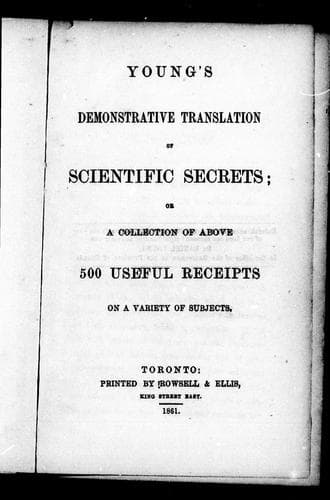
Young's Demonstrative Translation of Scientific Secrets: Or, A Collection of Above 500 Useful Receipts on a Variety of SubjectsYoung, Daniel
Science
Young's Demonstrative Translation of Scientific Secrets: Or, A Collection of Above 500 Useful Receipts on a Variety of Subjects
Young, Daniel
Formulas, recipes, etc.; Science -- Methodology
Get the blue composition; it may be had at the druggist's, or
clothier's, for a shilling an ounce. If the articles are not white,
the old colours should all be discharged by soap or a strong
solution of tartaric acid, then rinsed; 12 or 16 drops of the
composition, stirred into a quart-bowl of warm water, and strained
if settlings are seen, will dye a great many articles. If you want
a deeper colour, add a few drops more of the composition. If you
wish to colour cotton goods, put in pounded chalk to destroy the
acid, which is very destructive to all cotton; let it stand until
the effervescence subsides, and then it may be safely used for
cotton or silk.
205. FOR LILAC COLOUR
Take a little pinch of archil, and put some boiling-hot water upon
it, add to it a very little lump of pear-lash. Shades may be altered
by pear-lash, common slat, or wine.
206. TO COLOUR BLACK
Logwood and cider, boiled together in iron, water being added for
the evaporation, makes a good durable black. Rusty nails or any bits
of rusty iron, boiled in vinegar, with a small piece of copperas,
will also dye black; so will ink powder, if boiled with vinegar. In
all cases, black must be set with copperas.
207. TO DYE LEMON COLOUR
Peach leaves, bark scraped from the barberry bush, or saffron,
steeped in water, and set with alum, will colour a bright lemon,
drop in a little gum-arabic to make the articles stiff.
208. TO DYE ROYAL PURPLE
Soak logwood chips in soft water until the strength is out, then add
a teaspoonful of alum to a quart of the liquid; if this is not
bright enough, add more alum, rinse and dry. When the dye is
exhausted, it will colour a fine lilac.
209. TO DYE SLATE COLOUR
Tea grounds, boiled in iron vessels, set with copperas, makes a good
slate colour. To produce a light slate colour, boil white maple bark
in clear water, with a little alum. The bark should be boiled in
brass utensils. The goods should be boiled in it, and then hung
where they will drain and dry.
210. TO DYE SCARLET
Dip the cloth in a solution of alkaline or metallic salt, then in
a cochineal dye, and let it remain some time, and it will come out
permanently coloured. Another method: 1/2 lb. of madder, 1/2 oz. of
cream tartar, and 1 oz. of marine acid to 1 lb. of cloth; put it
all together, and bring the dye to a scalding heat; put in your
materials, and they will be coloured in ten minutes. The dye must be
only scalding hot. Rinse your goods in cold water as soon as they
come from the dye.
211. TO COLOUR A BRIGHT MADDER
Public-domain text, read in full here on John Shaqi.
Reviews
Reviews
No reviews yet
Be the first to share your thoughts on this work.
Join the Discussion
Join the discussion
Sign in to leave a comment or review.
Sign InorCreate an account