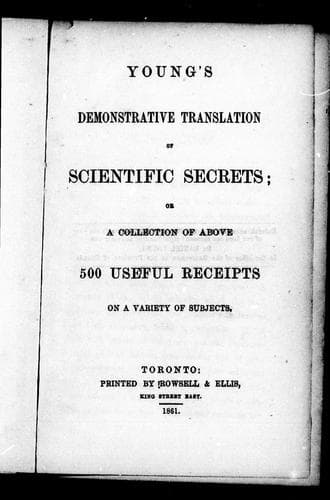
Young's Demonstrative Translation of Scientific Secrets: Or, A Collection of Above 500 Useful Receipts on a Variety of SubjectsYoung, Daniel
Science
Young's Demonstrative Translation of Scientific Secrets: Or, A Collection of Above 500 Useful Receipts on a Variety of Subjects
Young, Daniel
Formulas, recipes, etc.; Science -- Methodology
Dissolve one ounce of nitrate of silver, in crystal, in 12 ounces
of soft water; then dissolve in the water two ounces of cyanuret of
potash; shake the whole together and let it stand until it becomes
clear. Have ready some 1/2 ounce vials, and fill them half full
of whiting, then fill up the bottles and it is ready for use. The
whiting does not increase the coating powder--it only helps to
clear the articles and save the silver fluid by half filling the
bottles. The above quantity of materials will cost about $1.62c.,
so that the fluid will be about 3 cents a bottle. It is used in
the same way as the gold plating fluid.
12. QUICKSILVER PLATING FLUID
Take of quicksilver one ounce, one ounce nitric acid, one ten
cent piece, rain water 1/2 pint to a pint, put the three first
articles into a tumbler together; let them stand until dissolved,
occasionally stirring, then add the water, and it is ready for use.
This is used in the same way as the silver and gold plating fluid.
13. TO GILD STEEL
Pour some of the ethereal solution of gold into a wine-glass,
and dip into it the blade of a new penknife, lancet, razor, &c.,
withdraw the instrument and allow the ether to evaporate, the blade
will then be found to be covered with a beautiful coat of gold; the
blade may be moistened with a clean rag or a small piece of very dry
sponge dipped into the ether, and the same effect will be produced.
14. TO GILD COPPER, BRASS, &c.--BY AN AMALGAM
The gilding of these inferior metals and alloys of them is effected
by the assistance of mercury with which the gold is amalgamated. The
mercury is evaporated while the gold is fixed by the application of
heat, the whole is then burnished of left mat in the whole or in
part, according as required.
15. GILDING GLASS AND PORCELAIN
Dissolve in boiling linseed oil an equal weight either of copal or
amber, and add as much oil of turpentine as will enable you to apply
the compound or size thus formed as thin as possible to the parts of
the glass intended to be gilt; the glass is to be placed in a stove
till it is so warm as almost to burn the fingers when handled. At
this temperature the size becomes adhesive, and a piece of leaf
gold applied in the usual way will immediately stick. Sweep off the
superfluous portions of the leaf, and when quite cold it may be
burnished, taking care to interpose a piece of india paper between
the gold and the burnisher. It sometimes happens when the varnish is
not very good that by repeated washing the gold wears off; on this
account the practice of burning it in is sometimes had recourse to;
for this purpose some gold powder is ground with borax, and in this
state applied to the clean surface of the glass by a camel hair
pencil; when quite dry the glass is put into a stove, heated to
about the temperature of an annealing oven, the gum burns off; and
the borax, by vitrifying, cements the gold with great firmness to
the glass, after which it may be burnished.
Public-domain text, read in full here on John Shaqi.
Reviews
Reviews
No reviews yet
Be the first to share your thoughts on this work.
Join the Discussion
Join the discussion
Sign in to leave a comment or review.
Sign InorCreate an account