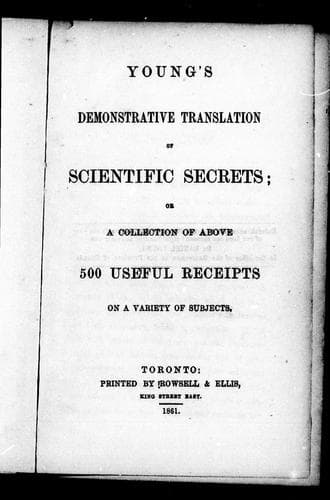
Young's Demonstrative Translation of Scientific Secrets: Or, A Collection of Above 500 Useful Receipts on a Variety of SubjectsYoung, Daniel
Science
Young's Demonstrative Translation of Scientific Secrets: Or, A Collection of Above 500 Useful Receipts on a Variety of Subjects
Young, Daniel
Formulas, recipes, etc.; Science -- Methodology
latter may be strained on a drawing or any other smooth board, by
damping the sheet, and after pasting the edges, stretching it down
while damp. Silk, linen, or other stuffs require to be carefully
stretched on a knitting or other suitable frame. Take great care to
allow, whatever you use, time to dry before applying the liqueur
diaphane. All kinds of screens, lamp-shades, and glasses, lanterns,
&c., &c., may be made in this way, as heat will produce no effect
upon them. The transparent pictures are successful, because they may
be hung on a window frame or removed at will, and the window blinds
are far superior to any thing of that kind that have yet been seen.
Instead of steeping the designs in the transparent liquor at the
time of printing them, which was previously done in order to show
their transparency to the purchaser, but which was practically
objectionable, as the paper in that state was brittle, and devoid
of pliancy, necessitating also the use of a peculiarly difficult
vehicle to manage (varnish) in applying it to the glass, the
manufacturer now prepares his paper differently, in order to allow
the use of parchment size in sticking them on the glass. The
liqueur diaphane, which is finally applied, renders them perfectly
transparent. In this mode of operation, no delay is requisite, the
designs being applied to the glass immediately after laying on the
size, taking care to press out all the air bubbles, for which
purpose a roller will be found indispensable. The designs should be
damped before the size is applied to them. We are of opinion that
this art may be applied to the production of magic-lantern slides,
dissolving views, and dioramic effects; though we are not aware
whether such experiments have been tried.
551. WATER-COLOURS USED IN DRAWING
Indian Ink.--The best is stamped with Chinese characters, breaks
with a glossy fracture, and feels smooth when rubbed on the plate.
Hair Pencils are made of camel's-hair; if they come to a point, when
moistened, without splitting, they are good.
Drawing Paper.--That made without any wire marks, and called wove
paper, is the best; it is made of various sizes and thicknesses.
To make a good white.--Clarify white lead with white-wine vinegar.
After the powder has settled, pour off the vinegar, put the powder
into a glass of water, stir it, and pour the water off while it is
white into another glass; when it is settled, pour off the water,
and an excellent white will be obtained. To this add gum enough to
give it a gloss.
552. DIRECTIONS FOR MIXED COLOURS
Ash Colour.--Ceruse white, Keating's black and white, shaded with
cherry-stone black.
Bay.--Lake and flake white, shaded with carmine; bistre and
vermilion shaded with black.
Changeable Silk.--Red lead and masticot water, shaded with sap-green
and verdigris.
Another.--Lake and yellow, shaded with lake and Prussian blue.
Cloud Colour.--Light masticot, or lake and white, shaded with blue
verditer.
Public-domain text, read in full here on John Shaqi.
Reviews
Reviews
No reviews yet
Be the first to share your thoughts on this work.
Elsewhere in the archive
Join the Discussion
Join the discussion
Sign in to leave a comment or review.
Sign InorCreate an account