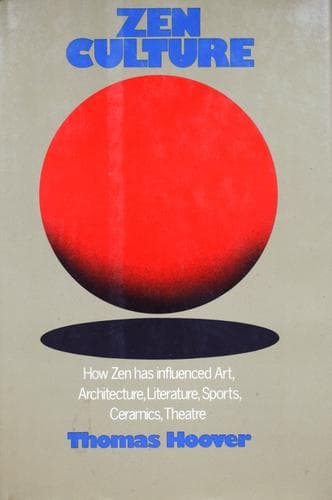
When examined closely, Zen culture in Japan reveals at least three
interrelated aspects or faces. First there are the fine arts, creations
of beauty but also devices whereby the Zen masters transmit otherwise
inexpressible insights. Interestingly enough, the Zen masters did not
trouble to invent new art forms but rather co-opted existing Japanese
(and sometimes Chinese) forms and revised them to suit Zen purposes.
During medieval times, the Chinese-style gardens so favored by the
Japanese aristocracy were adopted for use around Zen temples, but not
before they were first converted into small-scale landscape "paintings"
and later into monochrome abstractions. Chinese ink painting, both that
of the Sung academy and that of eccentric Chinese Ch'an monks, was
imported and made the official art of Zen. Ideas from Shinto
architecture were combined with design details from mainland Ch'an
monasteries to produce the Zen-inspired classic Japanese house. Various
types of rustic dramatic skits popular among the Japanese peasants were
converted by Zen aesthetes into a solemn theater experience called the
No, whose plays and narrative poetry are so austere, symbolic, and
profound as to seem a kind of Zen Mass.
In the later years of popular Zen culture, poets revised the standard
Japanese poetic form, which might be compared loosely to the Western
sonnet, into a shorter, epigrammatic expression of the Zen outlook--the
seventeen-syllable Haiku. Zen ceramics are a curious mixture of
Japanese folk craft and Chinese technical sophistication; flower
arranging is a link between Zen and the Japanese love of nature,
blossoms and beauty; even formal Japanese cuisine is often more a
celebration of Zen ideals than a response to hunger. The famous
Japanese tea ceremony evolved from a Chinese party game into a solemn
episode for the celebration of ideal beauty, inner calm, and the Zen
concept of living.
Public-domain text, read in full here on John Shaqi.
Reviews
Reviews
No reviews yet
Be the first to share your thoughts on this work.
Join the Discussion
Join the discussion
Sign in to leave a comment or review.
Sign InorCreate an account