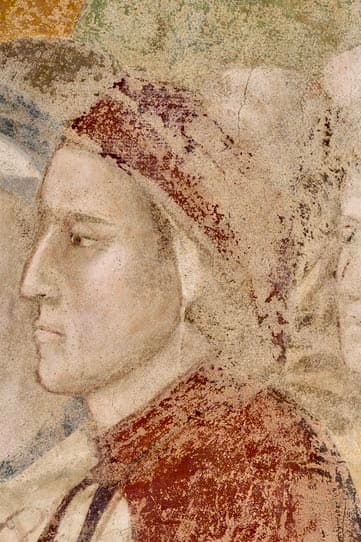
Dante Alighieri was a Florentine of minor nobility who fought at Campaldino, held his city's highest office, and was condemned to be burned alive when the political wheel turned in 1302. He never saw Florence again. Out of twenty years of exile — "how salt the bread of others tastes," he wrote — came the Divine Comedy, the poem that built the medieval Christian cosmos in words and then outlived it.
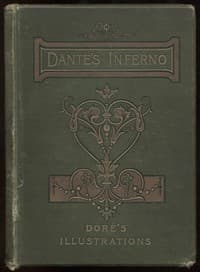
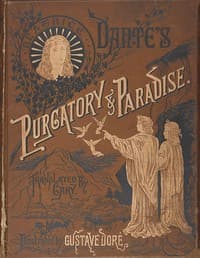
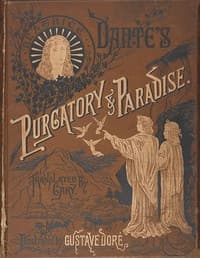
The Commedia is one hundred cantos in terza rima, an architecture as deliberate as a cathedral: Inferno's nine descending circles, where the punishment is the sin made visible — the lustful blown forever on the winds they rode in life; Purgatorio's seven terraces of hope and discipline, the most humane of the three realms; Paradiso's spheres of light, ending in the vision of the Trinity where "my desire and my will were turned... by the Love that moves the sun and the other stars."
He is in this library because the poem is philosophy as much as poetry. Its theology is largely Aquinas set to music; its ethics Aristotle's, graded into a moral geography; and its boldness startling — popes stuffed head-down in Hell's rock, his guide a pagan (Virgil, reason personified), and the Muslim philosophers Ibn Sina and Ibn Rushd honored in Limbo beside the sages of Greece, with Saladin nearby. Beatrice — the Florentine girl he loved from afar and lost — is transfigured into revelation itself, the claim that a particular human love can be a ladder to God.
His treatises matter too: De Monarchia argued empire and papacy rule by separate divine mandates (the Church burned it); De Vulgari Eloquentia defended writing in the vernacular, which the Comedy proved. He died in Ravenna in 1321. Florence still asks for the bones; Ravenna keeps them.