Book of Healing
Arabic
Full text coming soon
ابن سينا
Persia
Persian polymath whose Canon of Medicine and Book of Healing shaped science and philosophy for centuries.
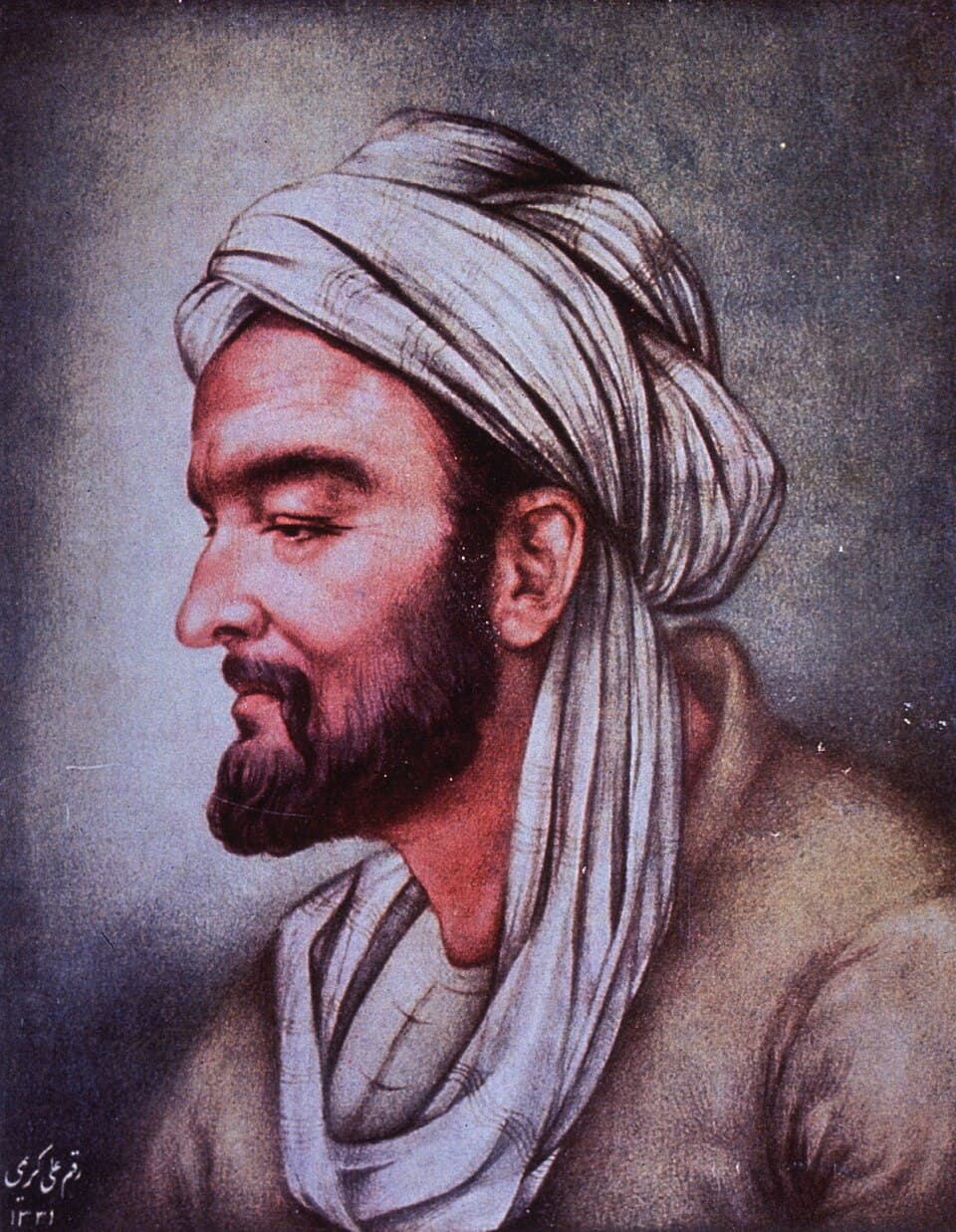
Ibn Sina — Avicenna to the Latin West — was the most influential philosopher of the Islamic world and, for centuries, of Europe's medical schools as well. Born near Bukhara, a self-described prodigy who had the Qur'an by heart at ten and was practicing medicine at sixteen, he lived a turbulent life across the courts of Persia — vizier by day, writing philosophy by night, sometimes composing in prison or on horseback.
Two encyclopedias carry his fame. The Canon of Medicine (al-Qanun fi al-Tibb) systematized Greek and Arabic medicine so thoroughly that European universities taught from it into the seventeenth century. The Book of Healing (Kitab al-Shifa) — despite the title, a philosophical summa — spans logic, physics, mathematics, and metaphysics.
His central metaphysical move still structures the debate about God's existence. Everything whose essence does not include existence, he argued, is merely contingent: it exists only through another. But a chain of contingent beings cannot explain itself; there must be something whose very essence is to exist — the Necessary Existent (wajib al-wujud), one, simple, immaterial. This proof from contingency, refined by Aquinas and contested by Hume and Kant, remains the strongest form of the cosmological argument. His "floating man" thought experiment — a person created in mid-air, senseless, who would still affirm his own self — anticipated Descartes' cogito by six centuries as an argument that the soul is not identical with the body.
Al-Ghazali attacked him by name in The Incoherence of the Philosophers, condemning his teachings on the world's eternity and God's knowledge of particulars. The quarrel that followed — Ibn Rushd answering Ghazali, theologians absorbing Avicennan logic even while refuting him — set the agenda of Islamic thought for five hundred years.
Arabic
Quote Attribution
Identify the philosopher behind a quote using AI.
Works by and about Ibn Sina — readable in full, right here in the Library.