A Discourse Upon the Origin and the Foundation of the Inequality Among Mankind
en
Equality; Natural law; Political science
Geneva
Genevan philosopher of the general will whose ideas fueled the age of revolutions.
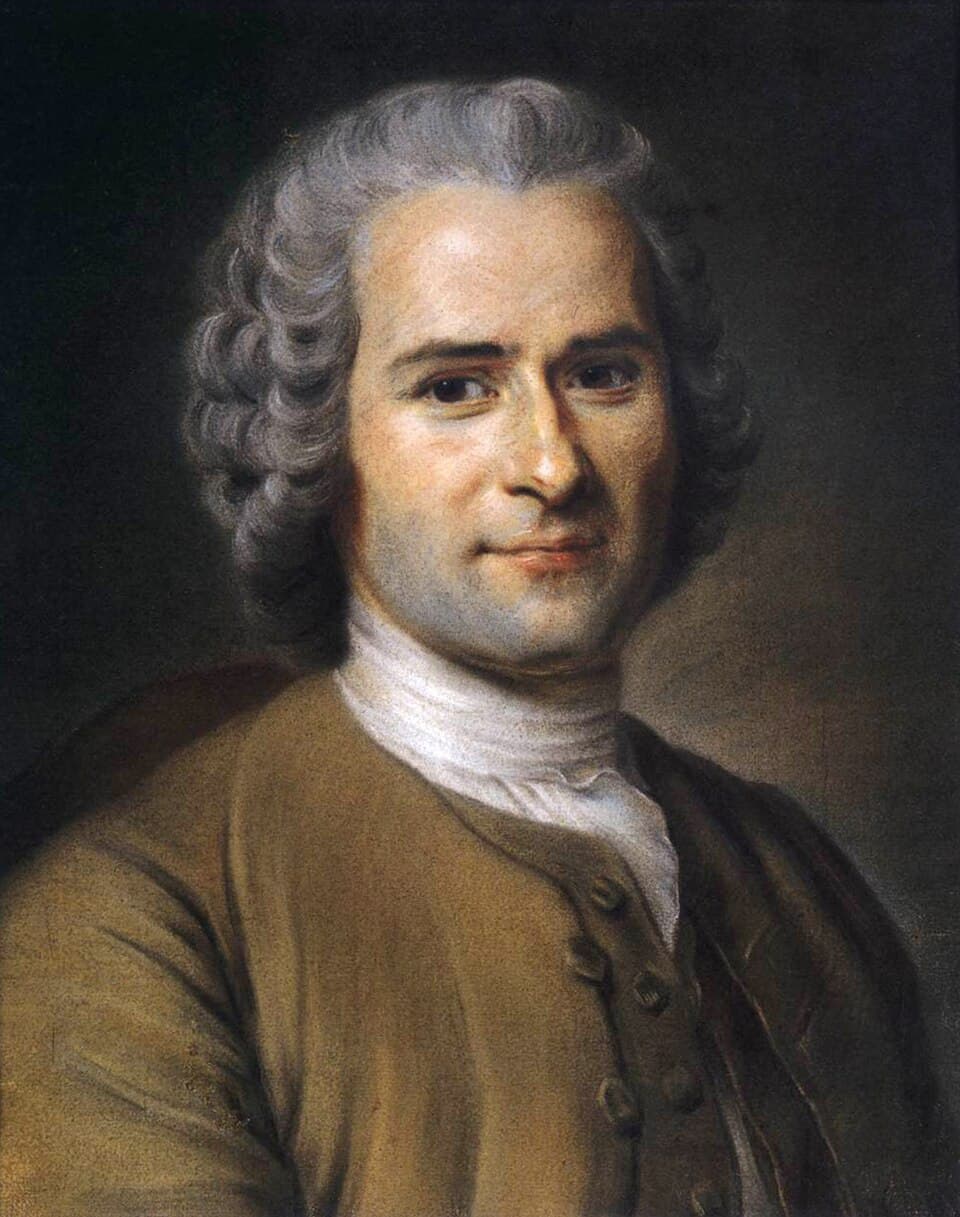
Jean-Jacques Rousseau — watchmaker's son of Calvinist Geneva, runaway at fifteen, convert and re-convert, self-taught composer whose opera charmed the French court he then refused — was the Enlightenment's inside critic and the modern age's first confessional self.
His entry came by lightning: the Discourse on the Sciences and Arts (1750) answered an essay prize by arguing that the arts and sciences had corrupted morals. The Discourse on Inequality (1755) deepened the case with a conjectural history: natural man, solitary and content, is deformed by property, comparison, and amour-propre — the restless self-regard born of others' eyes. Evil, for Rousseau, is social, not original: a direct rebuttal of the doctrine of original sin, and one reason Paris and Geneva both burned his books.
The Social Contract (1762) opens with the most quoted sentence in political philosophy — "Man is born free, and everywhere he is in chains" — and seeks legitimacy in the general will of a self-legislating people. Its closing chapter on civil religion — tolerant of all faiths that tolerate others, intolerant of theocracy — was read as blasphemy and revolution at once.
Emile (1762), his treatise on education, contains the Profession of Faith of the Savoyard Vicar: religion grounded not in miracles, books, or priests but in conscience — "divine instinct" — and the felt order of nature. It offended orthodoxy (revelation demoted) and the philosophes (materialism refused) equally; warrants were issued for his arrest the week of publication, and he spent years as Europe's most famous fugitive, quarreling tragically with Hume in England.
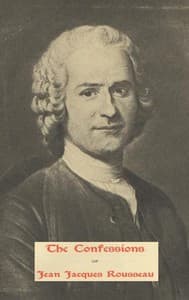
The Confessions, published after his death in 1778, invented modern autobiography. Robespierre kept a bust of him; the Romantics kept his heart. Liberal theology's turn from proof to feeling — Schleiermacher's "sense and taste for the infinite" — walks a path the Vicar cleared.
en
Equality; Natural law; Political science
en
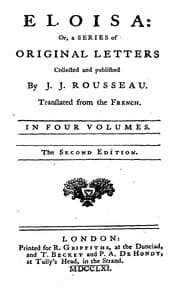
Alps Region -- History -- 18th century -- Fiction; Epistolary fiction; French fiction -- Translations into English; Man-woman relationships -- Fiction; Psychological fiction; Women -- Fiction




en
Authors, French -- 18th century -- Biography; Rousseau, Jean-Jacques, 1712-1778
en
Authors, French -- 18th century -- Biography; Rousseau, Jean-Jacques, 1712-1778
en
Authors, French -- 18th century -- Biography; Rousseau, Jean-Jacques, 1712-1778
en
Authors, French -- 18th century -- Biography; Rousseau, Jean-Jacques, 1712-1778
en
Authors, French -- 18th century -- Biography; Rousseau, Jean-Jacques, 1712-1778
en
Authors, French -- 18th century -- Biography; Rousseau, Jean-Jacques, 1712-1778
en
Authors, French -- 18th century -- Biography; Rousseau, Jean-Jacques, 1712-1778
en
Authors, French -- 18th century -- Biography; Rousseau, Jean-Jacques, 1712-1778
en
Authors, French -- 18th century -- Biography; Rousseau, Jean-Jacques, 1712-1778
en
Authors, French -- 18th century -- Biography; Rousseau, Jean-Jacques, 1712-1778
en
Authors, French -- 18th century -- Biography; Rousseau, Jean-Jacques, 1712-1778
en
Authors, French -- 18th century -- Biography; Rousseau, Jean-Jacques, 1712-1778
en
Authors, French -- 18th century -- Biography; Rousseau, Jean-Jacques, 1712-1778

en
Economics; Political science -- Early works to 1800; Social contract

en
Quotations
Quote Attribution
Identify the philosopher behind a quote using AI.
Works by and about Jean-Jacques Rousseau — readable in full, right here in the Library.